Monday, September 26, 2011

Anatomy and Physiology series: The Peripheral Nervous System

Hey, hey, hey...wait a minute here!  Where's the post on the physiology of the articulation system?  Did I seriously just post several posts full of boring old artic. muscles and skip the physiology?!  How dare I?!  If any of my regular readers (if I have regular readers) are currently feeling that way, have no fear!  I'm gonna get to it.  I'm taking a detour and going over the nervous system, peripheral and central, first because the physiology of the articulation system is actually still a bit of a mystery.  What we do know is that how the articulatory system all works together has a lot more to do with the nerves that control speech than it does the muscles themselves, so to understand the mystery, we've got to understand the nervous system...at least to some extent.  So welcome to the post on the peripheral nervous system.

The peripheral nervous system consists of all the nerves and nervous system connections that lie outside of your brain and spinal cord.  (The brain and spinal cord make up the central nervous system, which will be the topic of my next A&P post.)

I've decided to not go into the super small details of how neurons talk to one another...their axons, dendrites, terminal buttons and neurotransmitters...but if any of you happen to feel jipped and would really like me to post on that, let me know.  (Geeks are always willing to geek out even more if given the opportunity. :p)  But I do want to talk about some terms of the PNS and its basic divisions:  The somatic system, autonomic system and also the sympathetic and parasympathetic systems, which are both part of the autonomic system.


The nerves in peripheral nervous system are divided into two basic groups by their function:  afferent and efferent.  Afferent nerves carry their signal up the body back to the brain, and efferent nerves carry their signal out of the brain and down to the rest of the body.  Afferent nerves are considered sensory nerves, because all sensory information is sent to the brain for processing (think of them like the "paper work" of the body being sent of to the central office for processing and filing).  Efferent nerves are classically classified as motor nerves, because motor impulses are what go out of your brain to your muscles so you can complete the tasks your brain says  you should do.  (And I'm going to rip off the little mnemonic my professor taught us:  "A" stands for arriving, so "afferent" nerves are arriving at the brain, "E" stands for "exiting", so efferent nerves are exiting the brain.  And I'm going to let that go unaccredited because I don't know if she would want me including her name here, and also because I'm pretty sure she wasn't the only one to think of that one.)  Now, I'm going to stick to the traditional classification of afferent being sensory and efferent being motor, but you should know that in reality, there are mixed nerves that do both jobs, but they are usually classified by how the nerve function can be assessed (motor or sensory).

The somatic nervous system is the easiest one to talk about.  It's associated with the motor control of your voluntary skeletal muscles.  So that means that for every time you want to raise your arm or walk around, your somatic nervous system is handling those motor tasks.  What the somatic system is not involved in is any sensory information, such as someone touching your arm or leg, or any reflexes that occur, such as when you touch a hot surface.  Any muscle movement under your conscious control involves the somatic system.  So does that mean that the autonomic has to do with involuntary?  Well...not completely.  In fact, the autonomic system can still play a part in the function of skeletal muscle, but only when it's not involved in conscious control.

So how does the autonomic system work?  Well, this system does control involuntary muscles, like your heart and digestive muscles, but it does also impact the background tonicity of the skeletal muscles involved in things like keeping you erect when sitting up.  For example:  When you're maintaining a certain posture, you don't maintain it through conscious thought, but nerve impulses are still sent via the autonomic system to maintain partial-contraction of the proper muscles to keep you upright.  Any voice teacher or voice student has probably experienced this when a singer starts out a vocalise with great posture when instructed to think about it, but the posture slowly returns to that person's typical "steady state" posture as soon as they stop focusing on it.  (This is probably why my teacher just stopped working on posture with me a few months after I started a regular yoga workout.  My background tonicity was strong enough to maintain a healthy posture without my thinking about it...I guess.)  Breathing is usually a part of the autonomic system, but it can be put under conscious control, (and all singers out there say "duh") which would involve the somatic system.  But breathing rate is usually autonomic, and is determined in part by either the sympathetic or parasympathetic systems.

A lot of folks have heard about the sympathetic and parasympathetic systems, and I've met a few folks who seem to think of one as "bad" and the other as "good."  I suspect this is mostly related to reports about the effects of chronic stress on our systems, but in general, these two nervous systems compliment one another.  And when you get down to it, these systems are not as cut-and-dry as we usually talk about them...but I'll talk about them that way anyway just cause it's easier that way.

The sympathetic nervous system is in charge of our "fight or flight" response.  When activated, like say...when you're nervous before that big audition, this system raises your heart and breathing rate, makes you sweat, and raises your blood pressure.  The only thing it doesn't "turn on" is your digestion;  digestion is actually turned off by this system, which is why eating before a performance is a bad idea...for me, at least.  This system also turns on the more primal parts of your brain that assess a threat, (which I believe might be why at an audition, you remember every detail of every judge...they are the "threats" your brain detects, so they're the ones you notice the most.)  (This one also causes a bit of our endocrine (hormonal) system to kick in, which is why calming down after kicking it in can take a while:  Those hormones can still be in the blood stream for a while.)

The parasympathetic nervous system is in charge of our "rest and repose."  This system "turns off" everything that the sympathetic nervous system turns on:  it slows our breathing and heart rate, lowers our blood pressure, and turns on our digestive system.  When you're just hanging out at home, this system is maintaining your resting state.  Deep breathing and other relaxation techniques can help to kick in the parasympathetic system during a nervous state, but they might not work totally if you're blood is flooded with adrenaline and such...hence why it might take you a few phrases into your performance before you calm down a bit.  (But practicing relaxation before a performance is always a fruitful and useful thing to do, in my opinion.)

Alrighty, so moving on to the central nervous system next.  If you have any questions, please feel free to post them, and I'll do my best to answer.

*Seikel, J. A., King, D. W., & Drumright, D. G. (2010). Anatomy and physiology for speech, language, and hearing. Clifton Park, NY: Delmar. 

Friday, September 16, 2011

Anatomy and Physiology series: Facial musculature

So...facial muscles...yeah.  I was debating with myself on whether or not I was going to write on the facial musculature that is part of our articulatory system (not all our facial muscles...that would just get way too long.)  To be honest, I'm really eager to get to the nervous system since that's where I feel the really important physiology comes in (and it's the system that is usually ignored in voice pedagogy texts and classes), but I decided, in an effort to be thorough, to include these muscles here just so folks know what they are and what they do.

The first muscle is the orbicularis oris.
This muscle basically makes up your lips (along with a mucus membrane and epithelial layer), and it's your oral sphincter muscle.  Some folks classify this muscle as two separate parts:  The obicularis oris superior and inferior, which makes sense, because the function of the orbicularis oris is to close your mouth.  For reals.  It also serves as a point of insertion for a lot of other facial muscles and moves in conjunction with those other muscles to form a lot of facial gestures.

The risorius muscle (which I always felt is a funny-sounding name for a muscle) comes from the masseter, and inserts into the orbicularis oris.
This guy retracts the lips from the corners.  

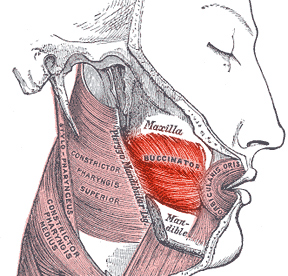
Another muscle that also pulls the lips back is the buccinator, which lies deep to the risorius.  
It originates from a ligament (specifically, the pterygomandibular ligament) on the bottom jaw, or mandible, and inserts into the orbicularis oris.  It also helps out a lot during chewing.  

The levator labii superious comes from the upper jaw bone, or maxilla, and inserts into the middle-side of the upper lip. 
This muscle elevates the upper lip when contracted.  

Then we have the zygomatic major and zygomatic minor muscles.  
Zygomatic Major

Zygomatic Minor
Zygomatic major originates from the zygomatic bone and inserts into the corner of the orbicularis oris.  It elevates the upper lip and also pulls back the angle of the mouth.  Zygomatic minor also comes from the surface of the zygomatic bone and inserts into the mid-side of the upper lip. It elevates the upper lip.  

The depressor labii inferioris originates from the mandible and inserts into the lower lip.  
This muscle pulls the lips down and out, which also happens to open the lips up a bit (you can also think of this as the "pouting" muscle).

The depressor anguli oris comes from the mandible and inserts into the orbicularis oris at the upper corners.  
This guy lowers the corners of the mouth and helps to compress the upper lip to the lower lip.  

The mentalis comes from the mandible and inserts into the skin of your chin. 
This muscle pulls the lower lip out, as well as elevating and wrinkling the chin...so this could be thought of as the "pout" muscle's accomplice.  

Also, the platysma, which was mentioned here, makes another appearance, since it lowers the mandible and has a lot to do with jaw movement during speech...along with all the other jaw muscles, that is.  

Okay, so that'll be my last post on musculature for a while.  Now, I can get to what I consider the "fun stuff," the nervous system, physiology of articulation (which follows a bit of nervous system introduction) and a bit of the physics of sound.  Where is this all going?  I suppose I'm building up to my little theory of the relationship between vocal science and vocal pedagogy, what's sometimes missing from that relationship, and how this knowledge has really, really helped my singing along by quite a bit.

*Seikel, J. A., King, D. W., & Drumright, D. G. (2010). Anatomy and physiology for speech, language, and hearing. Clifton Park, NY: Delmar. 

Monday, August 8, 2011

A Short Hiatus

I'm really hoping to wrap up my Anatomy and Physiology series here pretty soon, but I'm also in the middle of a cross-state move my husband and I are making this week.  ('Tis the grand student-migration here in the USA!)  So, I might not get to the remaining posts I have planned particularly soon.  Perhaps posting will be a great way to take a break from the packing...if I have time to take breaks.  Oy.  Moving is the pits!

So bare with me, readers.  I will get to the end of that series!  If not this week, then when things settle down from moving...and I have internet connection again.  Thanks for reading!

Am I Good Enough? (a.k.a Mrs. Scaredy-Pants)

As I sit here and write this, I am currently staked out at my dinning room table with my feet propped up on a chair and my shoes still on.  I am hiding from a spider that is currently hiding from me.  Earlier this morning, a rather large wolf spider ran right inside my home when I opened my front door.  I tried to spray some bug-killer spray on it to no avail; it's just too fast!  I couldn't stomp on it because it kept putting itself right up next to furniture, under a bike helmet that's on the floor next to the bike, etc.  My husband and I are both arachnophobics, you see, so this spider is creating a bit of an issue for both of us.  However, he got to escape to work earlier today, and I'm stuck here until my lessons start up later today.  It does stuck being scared of such a little thing...a little, creepy, eight-legged, eight-eyed, fast-running thing that was last seen hiding around my couch somewhere.

My current deal-with-the-spider plan is to calm down enough to begin vacuuming the living room floor, since it needs it anyway.  Then, while fully armed with the vacuum, I can scoot the couch around and suck it up when it runs out.  This plan should go well...as long as said spider is still camping out near the couch.  If not....I guess I'll have more hiding to do today.  Sigh.

This spider-event has gotten me thinking about something else that has been bothering me lately, the age-old question:  Am I good enough?  I would wager that this question is one of the most common questions ambitious-types ask themselves.  I know it certainly haunted me all those years I was in music schools.  Let's face it, without the encouragement of someone at some point in our lives saying, "You know, you're really good at this," very few of us would develop the ambition to succeed in any given career.  And then, if after we get into the field, we don't receive some similar encouragement at some point, either in the form of a competition won, a role landed, or positive comments on major assignments turned in, then we start to lose the confidence that original person instilled in us.

That is certainly what happened to me in the music world.  I was always encouraged by a small number of very supportive faculty, but I always failed to land any tangible evidence that I "had the goods."  The truth is, having everything come down to a five or ten minute audition was not something I could handle.  I would put so much pressure on myself at that one performance that I would bomb it.

Now that I'm entering a field in traditional academia, I must say I'm liking the process of "how to impress" a lot more.  I can impress by writing an impeccable statement of purpose through writing multiple revisions and having it proofread by my profs in the field.  Also, I can devour as much research as I can at the schools where I am applying, study up for good GRE grades, and, of course, get a 4.0 GPA.  What is similar to music is that I have months and months to put together a package that presents me at my best.  What is different is that this package is all on paper, so as long as I successfully put that package together, I can't screw it up with a wad of phlegm, not taking a big enough breath for that one phrase, wearing the wrong shoes with that dress, etc.  I don't have to worry about getting sick on the plane, and I can even fly out on the red-eye if I visit the schools cause, heck, I'm not singing for them.  As long as my eyes are clear from the eye drops and that five-hour energy keeps me alert enough while meeting faculty, I'm golden.  My throat can feel dry and scratchy all it wants!

But I have to admit, I still struggle with that "Am I good enough?" question.  It's a pretty paralyzing thought.  If I let that question get the better of me, I lose all motivation...all that lovely forward-momentum I've been building the past year just evaporates.  So clearly, I cannot let this question get the better of me.  Perhaps I can find a middle-ground of being humble to the proper point of still being open enough to learn, but not be paralyzed with fear.  It's not like I never have options in life.  It's not like failure on this one path = failure at all of life.  Certainly not!  It's gotten pretty cliche to think of failures as opportunities, but when put in their proper place that's all they really are.  Opportunities that emerge after the crying, ice cream, chocolate, moping about the house for a few days, yoga classes, and lunches with friends that tend to follow after a particularly spectacular failure.  As long as the process of working through the failure doesn't get the better of  you, then there are always more options emerging around the corner.

So perhaps I am asking myself the wrong question.  It's not "Am I good enough," but, "Am I motivated and capable enough to succeed in this endeavour?"  My answer to that is:  Yes.  Yes I am plenty capable, passionate, and motivated to do what needs to be done to be successful.  And really, that's all I need...which is convenient because that is all I actually have direct control over anyway.

...Not so sure how well this plan will work for the spider-situation though...

Friday, July 22, 2011

Anatomy and Physiology Series: Mandibular Musculature

I'm gonna truck right on through the mandibular musculature here, and go through some of the muscles of the lips next so I can get on to the interesting stuff about articulatory physiology and then the nervous system.  The mandibular muscles primarily function as muscles of mastication, but of course, the lower jaw is certainly involved in speech.
The mandible is your lower jaw bone, as you can see above.  There are eight muscles associated with elevating and depressing this jaw bone, so I'm going to start with the elevators.

The first mandibular elevator is the masseter
This is the big muscle you can see right where the man's cheek should be above.  This is the most powerful, and most superficial, of all the mandibular muscles...and if you suffer from TMJ (or TMD), then this muscle is the source of a lot of discomfort for you.  This muscle originates from the zygomatic arch (or cheekbone) and inserts into the mandible.  You can feel it bulge out near the outside of your cheeks if you clinch your teeth (hence why this muscle gets extremely tight in cases of TMD).  This muscle elevates the mandible, bringing the jaw closed.

The temporalis muscle is under (or deep to) the masseter, and it's bloody huge!
Seriously!  Look at that thing.

This muscle happens to be the reason I get tension headaches above my ears during exams.  (I tend to clinch my teeth during deep concentration.)   It originates from the zygomatic arch (or the "cheekbone") and inserts into the mandible.  This is the muscle that elevates and also pulls the jaw back if the jaw bone is protruded forward.  It also appears to be capable of more rapid movement than the masseter...but it's not as powerful as it. 

The medial pterygoid is not the name of a dinosaur, as much as the word "pterygoid" seems like it (at least I think so).  It originates from the medial pterygoid plate and inserts into the mandible.  This muscle acts along with the masseter to elevate the mandible. 
The arrow is pointing to the medial pterygoid, and the lateral pterygoid can be seen as the top muscle here.

The final elevator is the lateral pterygoid and comes from the sphenoid and inserts into the upper portion of the mandible (the part that comes right up near your ear.)  Contraction of this muscle moves the jaw forward, which is very useful when used along with the other elevators during chewing. 

The first depressor we'll go over is the diagastric muscle, which was also mentioned as a laryngeal elevator.  This muscle does elevate the larynx via it's connection to the hyoid bone, but it also depresses the mandible if both the anterior and posterior bellies work together.

In fact, a lot of the laryngeal elevators come back into the picture here.  The mylohyoid and geniohyoid are also both laryngeal elevators and mandible depressors.

The last mandibular depressor is the platysma, which is a large muscle of the face as well as a mandibular depressor.  This muscle originates from the tissue around the clavicle and inserts into the mandible and a few other facial muscles we'll go over next time.  It's runs above the sternocleitomastoid.
Don't know if you can read it when you zoom in, but the blue thing in the middle of the platysma is the jugular vein.  I think it's in the picture more for orientation.  The vein actually runs deep to a lot of the neck muscles.
I know it looks like one big, impressive muscle, but the truth is, it's not that strong.  This muscle's tissue is actually a rather thin layer of tissue, and so, it's not a very strong muscle.  It's more like the side-kick-best-friend of the other main characters, the stronger muscles of the face and neck.


*Seikel, J. A., King, D. W., & Drumright, D. G. (2010). Anatomy and physiology for speech, language, and hearing. Clifton Park, NY: Delmar.

Wednesday, July 20, 2011

Anatomy and Physiology series: Tongue musculature

The musculature of the tongue, much like that of the larynx, is divided into intrinsic and extrinsic musculature.  As such, the distinction is similar for that of the larynx:  Intrinsic muscles all have attachment points within the tongue structure and are involved in fine motor movement of the tongue, and all extrinsic musculature have one point of attachment within and one outside of the tongue and are involved in gross motor movements.  I'm going to start with the intrinsic muscles.

One more note:  The tongue is divided regionally into the tip (the front part that touches the teeth), the blade (the part that contacts the hard palate), the dorsum (the part that touches the velum), and the root.  The tongue root makes up the front wall of the pharynx, (which is why contraction of the root will directly impact the size, and therefore the, resonance of the vocal tract during speech and singing).

The superior longitudinal muscle makes up the upper layer of the tongue.  It is a fan-like muscle that runs from the area near the epiglottis all the way to the sides and front tip of the tongue.  It elevates, retracts (along with the inferior longitudinal muscle), and deviates (moves from one side to another), the tongue tip. 
Both superior and inferior longitudinal muscles can be seen here, but they're labeled as longitudinalis superior and inferior.
The inferior longitundinal muscle is the counter to the superior longitudinal.  It originates from the tongue root at the hyoid bone and runs to the tongue tip.  Contracting it pulls the tongue tip downward, retracts it (when simultaneously contracted with the superior longitudinal muscle), and deviates the tongue as well.  

The transverse muscle runs from the lingual septum to the sides of the tongue.  This muscle narrows the tongue. 

And finally, the vertical muscles of the tongue come from the base of the tongue and inserts into the membrane covering the tongue.  These muscles pull the tongue down into the mouth floor.  

Okay, so those are our intrinsic tongue muscles.  We have five extrinsic tongue muscles to go through.  Remember, these muscles are involved in gross motor movements, so while some of their functions might sound identical to the intrinsic muscles, the actual movement is much larger when the extrinsic muscle is contracted.
Extrinsic tongue muscles.  Click on it to zoom in and read the labels.
The first one is the genioglossus muscle.  This muscle originates at the inner side of your mandible (jaw bone), and fans inward to insert into the tongue tip and dorsum and the hyoid.  It's the big muscle in the front of the above picture.  What does it do?  Better question to ask is:  What doesn't it do?  So the front fibers of this muscle retracts the tongue, the back fibers protrude (or stick out) the tongue, and both sets of fibers contracted together end up depressing the tongue.  Whew.  It does a lot, doesn't it?

The hyoglossus comes from the hyoid bone and connects into the sides of the tongue.  Contraction pulls the sides of the tongue down.

The styloglossus comes from the styloid process and inserts into the bottom sides of the tongue.  Contraction moves the tongue up and back.

The chondroglossus is one of those funny muscles that is also considered to be a part of another muscle, the hyoglossus up there.  The reason it's listed separately sometimes is in its function:  It depresses the tongue.

And finally, the palatoglossus makes another appearance here because it does elevate the tongue while it pulls the soft palate down.  

Now when it comes to singing technique, we all do some battling with our tongue at some point in our vocal journey.  So does knowing these muscles automatically grant you some magical ability to be able to tell  your genioglossus to relax when you need it to?  NO!  Of course not.  Knowing the A&P of the musculature is just one part of knowing the A&P of the whole speech (or singing) system.  We've got to get to the neural organization that manages the whole system to understand why it's useful to know for teaching and/or singing, so hang in there and let me peel my intended onion for ya.

*Seikel, J. A., King, D. W., & Drumright, D. G. (2010). Anatomy and physiology for speech, language, and hearing. Clifton Park, NY: Delmar.

Anatomy and Physiology series: Muscles of the soft palate

Now, we're getting into the articulatory system...which also doubles as the chewing/swallowing mechanism.  We're gonna start with the soft palate, or velum.  The nice thing about talking about the articulatory system is that you can see most of it in action with your own open mouth and a mirror, but I'll put up a couple of pictures to help out anyway.

Front view of the velum from an opened mouth.  It ends at the uvula.
Side view of the velum.  Allows you to get an idea of how it opens and closes the nasal port.
The velum opens the nasal port when it's elevated, and closes the nasal port when it's depressed.  As such, there are velar openers and velar depressors.  There is also one curious little muscle that used to be thought of as an elevator, but we now know that it is not.  I'll also go over that one too.  So on to the elevators:

The levator veli palatini is the primary elevator of the velum.   It originates from the petrous portion of the temporal bone, and inserts into the palatal aponeurosis.  (I know that contains a fair number of heavy anatomical terms.  Seriously, the first time I heard the term "aponeurosis" my brain just went, "huh?".  If you've never heard of them before, just click the links to get a quick definition at the top of each page.)  This muscle elevates and pulls back, or retracts, the back of the soft palate when contracted.  
Another elevator is the musculus uvulae.  If you look at the first picture I posted, this is the muscle embodied within the uvula there.  Contraction of this muscle shortens the soft palate, basically bunching it up towards the back.  

The two depressors are the palatoglossus muscle and the palatopharyngeus muscle.  The palatoglossus originates from the palatal aponeurosis and inserts into the sides of the back of the tongue.  So, really, this is both a palatal and a tongue muscle.  Contraction both elevates the tongue and depresses the velum...but don't over think that as a singer, cause this coordination is all under the nervous system's control (so if it's functioning well for you, over-thinking it could muck up what's already working well.)  This is why I am going to culminate this whole A&P series with a introduction into the nervous system, so stay tuned for that!

The palatopharyngeus muscle is another duel-duty muscle, being both a palatal and pharyngeal muscle.  This guy originates from the hard palate and inserts into the back of the thyroid cartilage, so it's pretty long in comparison to others.  Contraction of this muscle both constricts the pharynx and lowers the soft palate.

*So here's a little physiology note:  When at rest, the velum is depressed, allowing us to breath through our nose comfortably.  So why do we need velar depressors?  Well, the velum is elevated most of the time during speech (or singing), but when we want to make nasal sounds, like /m/ /n/ or nasal vowels, we've got to depress it very quickly.  This is where the depressors come in, especially the palatoglossus.  Allowing the elevators to simply relax would be too slow for comprehensible, flowing speech.  

And the last muscle is the tensor veli palatini.  Did you go to the link and read about it?  Cause if you did, forget what you just read.  This is an instance where wikipedia is out of date and inaccurate.  For a long time, we thought this muscle tensed the velum thereby assisting the levator veli palatini in elevating the larynx, but we now know that this muscle doesn't elevate the velum at all.  It's sole function is to open the Eustachian tube to allow the air pressure in the middle ear to equalize.  This is the muscle at work when you either yawn or chew gum on a plane to get  your ears to "pop."  (This is also why babies always cry after take-off, cause they don't know to "pop" their ears, and this muscle doesn't work as well for them.  They're just uncomfortable when the pressure changes, and an uncomfortable baby is a crying baby.)

Up next is tongue musculature, which is gonna be a long post 'cause there's a lot of them!

*Seikel, J. A., King, D. W., & Drumright, D. G. (2010). Anatomy and physiology for speech, language, and hearing. Clifton Park, NY: Delmar.