Showing posts with label Vocal Pedagogy. Show all posts

Sunday, October 4, 2015

No more hiding: Videostroboscopy of my imperfect vocal folds

A few weeks ago, one of the voice-specialty speech-language pathologists (SLP) I currently work with wanted to see my vocal folds. The professor in my voice disorders class, who is also an SLP, had taken videostroboscopies of the students in class so that we got practice seeing them and seeing what a rigid videostroboscope feels like. So, this other SLP pulled up my file from class in spring of 2014.

Prior to this video being taken, I was enjoying thinking of my voice as functional and healthy. Seeing the paresis in action again, however, brought back the emotional memory of the first time I saw it. All the "how can I sing opera without an intact voice?" came flooding back into my head. Thus, I put the video away in a file on my computer and never looked at it past that spring semester in 2014. Until that SLP wanted to see it.

A few caveats: I wasn't tolerating the rigid scope very well (the one that goes in the mouth). I have a pretty hyper gag-reflex and I was certain I would gag the whole time, so the video is choppy and the SLP taking it never quite got a full shot of my vocal folds. I just want to say that the SLP who took this video is an amazing voice therapist and very skilled with the stroboscope. The fact that she never got a good look was entirely due to my hyper-reactivity. I just never managed to calm myself down! (The one at the ENT's office back in 2009 went through my nose.) The second caveat is that I wasn't singing regularly much at all at this point in time and I had a round of reflux that week so my vocal folds are a little swollen, but you can see the paresis still there.

When the other SLP wanted to see the video a few weeks ago, I realized that I had been avoiding it because I'm much happier thinking about my voice as healthy and functional for me. I've been practicing again and taking voice lessons again and my voice felt great! Why would I want to see it still being an issue? Then I realized that avoiding the video is silly. If I want to stick to my own philosophy of a balanced voice being the whole goal of technique, then I should learn to accept my whole voice--flaws and all. It still is functional for me right now. I am still able to express myself musically through my singing, so I should not be afraid of looking at my full voice for what it is at this moment.

With all that said, here's a little guide to interpreting this video. The front of the throat is at the bottom of the video and the back of the throat is at the top. You can see the epiglottis in full view at the bottom and you can see the root of the tongue where it meets the epiglottis there in most of the video as well. The opening to the esophagus is at the top of the video and is closed whenever you are not swallowing. (The muscle that closes the esophagus functions such that it's tonically closed during it's resting-state.) The right side of the screen is the left side of my larynx and vice versa. The vocal folds are the white strips of tissue you'll see in the middle of the screen--the posterior portion of the vocal folds are first visible around 00:20. There is a bit of redness there as well thanks to the reflux I was dealing with around that time. (I was having an issue getting my PPI prescription renewed with my doctor's office.)  The arytenoids are visible near the top of the video. These are the guys you want to keep your eyes on to see the paresis in action. The posterior glottic gap (i.e., the place where my vocal folds don't completely meet during phonation) extends further for me due to the paresis. This is where I "leak air" when I'm singing.


At 0:31:  You might need to stop and start the video in short bursts from here, but this is where you can see the left arytenoid doesn't go as far to midline as the right.  If you stop and start a few times, you can see the right arytenoid adduct smoothly and quickly. The speed with which the right arytenoid adducts makes it pretty clear the left arytenoid isn't traveling as far. It stops moving before the right arytenoid does.

At 0:48:  You can see the left arytenoid "crap out" (very technical term right there). It stayed in an adducted position, or as close as it gets to midline during adduction, so what you can briefly see is my right arytenoid adducting to meet it.

If you think you're seeing any bumps on my vocal folds that look like nodules or polyps, it's actually mucus. This is determined during stroboscopy by the very scientific method of having the patient clear their throat and swallow. If the bump moves off or moves to a different location, it's mucus.

So, those are my vocal folds as they are now (minus the swelling and redness from reflux). Yes, I can still sing with these folds and my voice doesn't fatigue during the day as long as I don't strain when I speak. Essentially, the biggest "enemy" to my being able to sing is tension, since it's still easy to want to "fight" with my voice, particularly on long phrases. But, I think if I stop hiding from my vocal flaws and learn to accept them, I'll start to sing better just by feeling more free to express myself flaws and all!

Edit to add:  Also, when I start to glide up the pitch, I start to shift my epilaryngeal area in the manner referred to as "covering" in the pedagogical literature. This is all great and good in the singing world, but it obscures the view of the vocal folds when using rigid stroboscopy. I should have tried for a more "choral sound" during my glide to maintain the laryngeal position. But, gliding is a check for the superior laryngeal nerve (that handles the action of the cricothyroid), and as you can hear, mine is pretty well-intact. Just the recurrent nerve (the one that handles the muscles of adduction and abduction) is a little impaired.

Saturday, August 22, 2015

The discussion begins!

I've had a great comment over on my other blog, Balanced Voice, that I would love to open up to a discussion in the comments.  If anyone has the time or inclination to give their two cents, I think it's an interesting topic that needs more exploration in the pedagogical world.
Check it out:  Technique vs. expression

Wednesday, June 17, 2015

New blog, new topics

Hello all!  Once again, I let this blog lag quite a bit.  Sorry for my absence.

I've been wanting to get back into blogging a great deal, but I've been stuck as to which direction to go in.  I wanted to share the things I've learned about the most effective ways people learn complex motor tasks, like riding a bike or, well, singing, but I also wanted to open up a place where voice teachers, singers, and voice scientists could comment and discuss the best ways to go about that.  So, I recently decided to make a new blog for that purpose.  This blog is going to be more narrowly focused than this one, and I'm hoping it will develop into a great place for any pedagogical questions or issues that arise for any of you.  I'm also hoping it can be a resource for new teachers to ask experienced teachers for advice if you're dealing with a tricky voice for the first time.

The current plan is to keep this blog going, but to keep the focus of this blog my own personal and academic journey.  The new blog will be where I discuss the scientific evidence from physiological and behavioral studies that I think is often missed in pedagogy coursework.  As such, I'm starting off this new one as if folks already have some basic, general knowledge of how the voice works physiologically.  I hope you'll check out this new blog and feel free to begin the discussion there on any questions or issues you're currently having, either with your own voice/singing training or as a voice teacher, any questions you have about what science can offer vocal pedagogy.

I hope to "see" you there!  http://balancedvoice.com

Saturday, October 18, 2014

You have a vocal injury? How did you do it?

Singing world: We have a serious problem, and it must stop.

This problem is so pervasive that it still exists in the clinical world too:  The idea that someone might "cause" their vocal injury, and in doing so, that they (or their private voice teacher) are somehow guilty of some horrendous wrong-doing.  (Side-note:  This mentally does not exist in any clinician that I would ever recommend to someone.  It still exists in some, but not all.)  (Okay, side-side-note:  I was just a guilty as everyone in this mentality prior to entering speech-language pathology, but I have turned 180 on these beliefs and I think everyone else should too.  Here is why.)

Let's start with this example:  The Olympic gold-medalist Lindsey Vonn.  If you clicked on the link, you'll read about how she wasn't able to complete in the 2014 Winter Olympics due to a knee injury.  

How many of you out there thought to yourself:  "Well, Lindsey Vonn is a terrible skier.  She just doesn't have good technique.  She doesn't even train with a good coach.  I heard she makes poor decisions in terms of what course to run, what competitions to sign up for, and when to stop.  She just doesn't have what it takes to really have a career as a skier."

Personally, I've never heard of anyone looking at a high-level athlete and scoffing at an injury they may sustain.  So why do we singers do that to each other?  Now replace "Lindsey Vonn" with "Maria Callas," "Natalie Dessay," or "Julie Andrews."  Do the above comments seem more justified all of the sudden?  If so, WHY?  Why are professional singers any different than high-level athletes?  Why would sustaining an injury of any kind make a singer (or their voice teacher) automatically deserving of scorn?

Here's the big secret that really shouldn't be a surprise:  No one intends to injure their voice!  It's an accident that's scary to deal with.  There is no reason people dealing with the emotional impact of those consequences should also carry the guilt of causing their injury.  It's not a necessarily a sign of poor singing technique and it also isn't necessarily a sign of bad voice teaching.  Often, the direct cause of an injury is very hard to determine.  (NOTE:  Cause is different than time of occurrence.  In some injuries, like a vocal hemorrhage, we can determine the time or day that the injury likely occurred.  However, the direct cause of the hemorrhage can still involve multiple variables.)

Did you ever:
-Go to an amusement park and lost your voice a little from screaming on the roller coasters?
-Sing a well-paying gig while sick because you had just enough voice to get through the gig?
-Go out to noisy restaurants/bars regularly with your friends/cast mates after singing for hours daily?
-Unknowingly sung (uncomfortably) with acid reflux for several months before getting looked at by your doctor?

I bet most of you have at least done one of the things on that list.  In some people, some of these behaviors can contribute to the developing of a voice disorder and in others, no disorder develops.  Truth is, even the best vocal scientists can't predict who will develop a voice disorder/injury and who won't.  Too many factors are at play.

Blame does nothing but inflict additional damage to someone dealing with a medical condition. Injuries are accidents that happen sometimes to good singers and that need to be dealt with in the best way possible.  That is all.  Vocal injuries for a singer are exactly like a knee injury for a pro skier.  Until we can travel back in time and prevent accidents from happening, guilt and blame does nothing but make it worse.  What is needed is a good plan to get the voice to a condition that, ideally, will meet the patient's vocal needs.  That is what a medical team (e.g., ENT & SLP) is for.

So perhaps the next time you hear someone say he/she is dealing with an injury, instead of saying "How did you do it?"  Say "Oh, I'm so sorry to hear that" and maybe offer condolences and wish them a speedy recovery.

We keep calling ourselves "vocal athletes."  It's time we start treating each other as such, especially when an injury occurs.

Monday, August 13, 2012

Physics of Sound: The Spectrogram (or what the heck am I looking at part 2)

I probably should give a little lesson on how to read a spectrogram, since my next post will feature spectrograms rather heavily.  I made all these spectrograms on PRAAT, which is free and downloadable if you wish to play with it.  (I know the website looks a little sketch, but I had to get it for my classes using the site I linked to and it's totally safe for your computer.)  PRAAT is a lovely piece of software that will record a sound and then give you both a spectrogram and a waveform of that sound.  As you look at the images below, the waveform is the image on the top with the thick black band and blue vertical lines, and the spectrogram is the grey-scale mess below that waveform.  So, on to the important part of this post!

How to read a spectrogram:

The x-axis (horizontal) is time, the y-axis (vertical) is frequency, and the grey-scale shows amplitude.  So a spectrogram can show three dimensions, time, frequency, and amplitude vs. a waveform that shows only two, time and frequency.  On fancier programs, the amplitude is sometimes shown in color, like having blue be the softest sounds and red being the loudest, but in PRAAT, the darker the band, the higher the amplitude.  In terms of the frequencies, I set the spectrograms to show from 0 Hz to 7000 Hz.  PRAAT can display up to 20,000 Hz, but then the formant bands I want to focus on get too squished together.  If you click and make the image bigger, you can see a dotted red line with a frequency number off to the left.  I set those lines there just to give you some idea of where the upper formant lies in terms of Hz.  And remember from the last post that the formant will be somewhere around this frequency, not right at the single frequency itself.

So this is what a typical spectrogram will look like with the upper frequency set at 7000 Hz.  (I think PRAAT's default setting is usually 5000 Hz.):


The spectrogram above is me sustaining the vowel /a/ with my speaking voice.  You can clearly see five dark bands going horizontally across the image, but the bottom two dark bands are the darkest, indicating that those are the highest amplitude formants.

Sustained-speech of an /a/ vowel with formants marked.
This is the same spectrogram as the one above it, but I've set PRAAT to show me the first five formants, which it does by adding in those red lines.  The software is simply determining where the highest amplitudes are and sticking bands in there.  I'm not controlling where those thick red lines go.

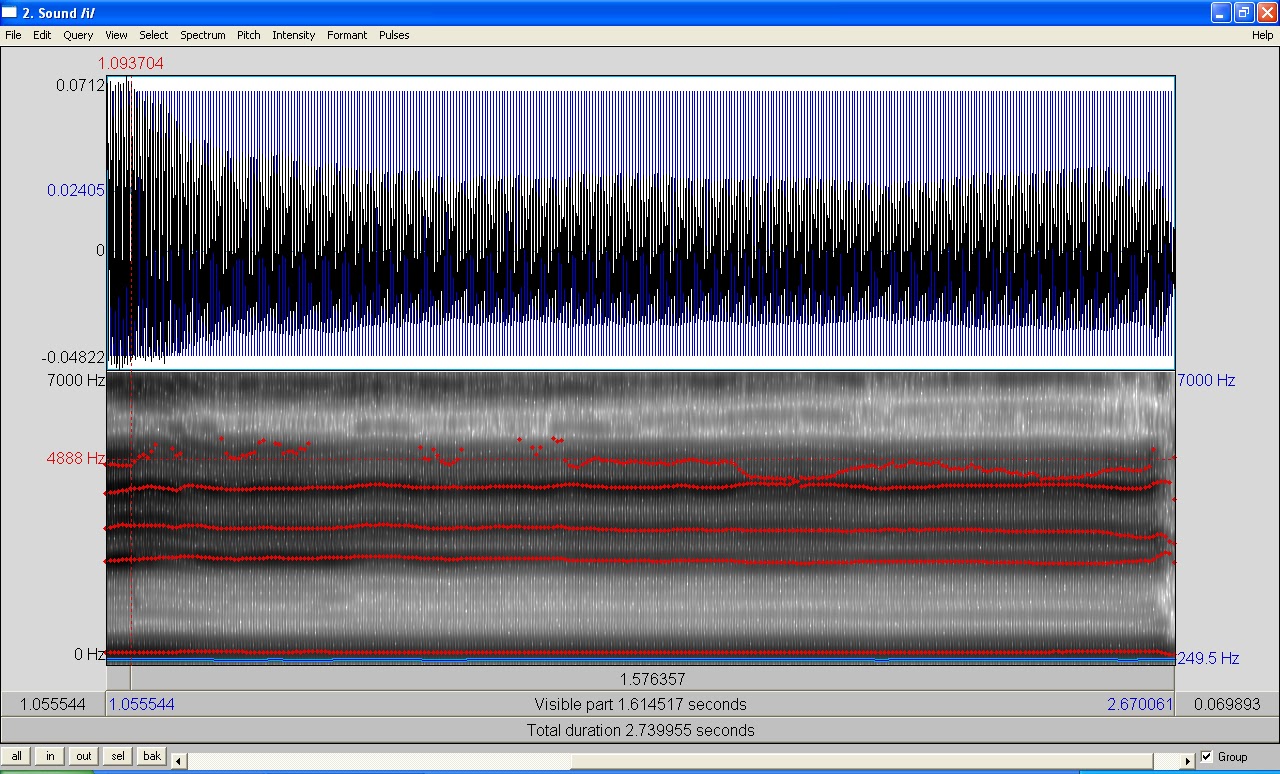
Sustained, spoken /i/ vowel, no formants marked in.
Here's me sustaining an /i/ vowel with my speaking voice.  Note the wide distance between the first and second formants, which is just what the /i/ vowel does.  Oh /i/, you so crazy!

Sustained, spoken /i/ vowel, first five formants marked in red.
Above is the same spectrogram again, but with PRAAT marking the first five formants in red.

Spoken phrase:  "One, two, three, go," no formants marked.
 And there's a spectrogram of me speaking the phrase, "one, two, three, go.'  Here, you can see the movement of the formants as I go through those words and the "white space" between the words.  (Those areas where there's a thick blue vertical band on the waveform is where the /t/ and the "th" sound of "two" and "three" are.  And, you can see the antiformants present in the /n/ sound right at the end of the first word "one."  Pretty cool, huh?)  (Scroll to the bottom of page 2 on that antiformant link to read more about them.) And here's the same phrase with the formants marked in:

"One, two, three, go," with formants marked in red.

Now, some super cool people can actually read spectrograms like they're reading words off the page.  I'm not quite that awesome yet, but if you tell me what the phrase is, I can pick out where each specific word is using my knowledge of vowel formants and consonant frequencies.  It'd be cool to become that person who can just read them, though!

Now the reason I kept setting the spectrogram to 7000 Hz instead of 5000 is two-fold:  First, I wanted to make sure the upper formant wasn't cut off since that formant does occasionally go higher than 5000 Hz, and second, I wanted you to see that there actually is a thick band of amplitude above the 5000 Hz mark, which you can see in the spectrogram above.  So there are more "formants" above that 5000 Hz mark...we just don't really regard frequencies higher than 5000 when discussing speech or singing very much.  (Although, this article does!)  Heck, PRAAT doesn't even mark in any formants above the 5000 Hz area...usually the fifth formant area.  But, I wanted to make sure you know that it's not like formants and harmonics just disappear above 5000 Hz.  Mathematically speaking, harmonics would just keep on going higher and higher, and so would formants.  However, the amplitude lessens the higher you go, so vocal harmonics and formants do dampen out eventually...just not at 5000 Hz.

Up next:  The singer's formant!  I'mma gonna break apart a common misconception in the hopes that it clarifies what is we're actually doing when we carry over that orchestra.

Physics of Sound Series: Formants, formants, and more formants

According to Raphael et al., the source-filter theory of speech production states that the source of vocal sound, i.e. the vocal folds, is filtered through the air spaces in the vocal tract (p. 330).*  This is a fairly simplistic model of vocal production, but it is very useful just because of its simplicity.  Other models of speech production out there get a lot more detailed, but for a general, conceptual knowledge of the relationship between the vocal folds and vocal tract in terms of acoustic output, I think the the source-filter model can't really be beat.

So what does this have to do with formants?  Well, on the last physics post, I left off by stating that the vocal tract can change it's shape and configuration to filter out different harmonics from the same sound source.  The shape of the vocal tract will also amplify certain harmonic frequencies, while dampening others.  The resulting "peaks" in amplitude at specific frequency ranges are what we call formants.  One important thing to note here is that formants are not the same thing as harmonics.  You can think of formants as being a certain specific collection of harmonics, so the first formant is not the same as the first harmonic.  The idea of a harmonic is that it is one particular sine wave that is related, mathematically, to the fundamental, but the formants are collections of these sine waves.  The language you typically see is that the first formant is around a specific frequency.  So while you might read about the singer's formant being somewhere around 3000 Hz, the formant isn't actually only at 3000 Hz, it's just a collection of frequencies centered somewhere around 3000 Hz.  I think the semantics might get a little fuzzy there for a lot of people, but what seems like a little, unimportant detail actually makes a big difference when discussing harmonics vs. formants.  If you use those terms interchangeably, you'll just confuse the folks who know they're different things and then you'll get confused that they're confused and yadda yadda yadda...

Think of it like this:  Let's say you have a collection of all the Star Trek episodes from every Star Trek series, even the crappy ones.  If you consider the first series, the original Star Trek, as the fundamental, the first "harmonic" would then be Star Trek:  The Next Generation, the second would be Deep Space Nine, the third Voyager, etc.  However, it's possible that if these "harmonics" get filtered into formants, the first formant could consist of the first five seasons of The Next Generation, with the last two seasons filtered down to really low amplitude.  The second formant could be the last four seasons of Deep Space Nine, with the first three seasons of DS9 being filtered down.  The third formant could be the last five seasons of Voyager with the first two seasons filtered down, etc.  See the difference?  So harmonics are the building blocks of formants, but harmonics come from the resonance of the vocal folds themselves and formants come from the resonance of the acoustic filter or vocal tract.

What's great about formants is that they happen to be the way we distinguish vowels during speech.  In fact, the relationship between vocal tract shape and the acoustic output (vocal sound once it exits the mouth) is so interrelated, we are able to classify vowels by both the vocal tract shape and the acoustic output, depending on what we're talking about.  I.e.:  Talking about articulation?  You'll be talking about the shape of the vocal tract made by the articulators (tongue, soft palate, etc.).

If you happened to click over to that Wikipedia article on vowels, you probably noticed there's a section on articulation and a separate section on acoustics.  The position of the tongue in the mouth happens to make the biggest difference to the overall shape of the vocal tract, and so, a lot of vowels can be categorized by place of tongue articulation during production.  For example:  An /i/ ("ee") vowel is categorized as a high, front vowel because the tongue is positioned very high near the roof of the mouth, but it is also positioned quite forward in the mouth and is, therefore, a high-front vowel.  A high-back vowel, such as /u/, has the tongue positioned as a "hump" near the back of the mouth, so it's high, but in the back.  A low vowel, such as /a/, doesn't involve the tongue in a raised position at all, and is closer to a neutral vowel position, of which the schwa sound is considered the most neutral.  (I know a lot of singers consider /a/ as the most neutral vowel, but linguists and speech scientists have researched tongue positions, and schwa is indeed the most neutral.  I think the reason singers like the focus on /a/ so much more is that we don't tend to sing schwa very often, and if we do, we don't sustain a sound on schwa.  So schwa gets kinda a bad-rap in the singing world, but it is an important little vowel in spoken language.)  

Because a larger space will resonant at lower frequencies, and a smaller one at higher frequencies, the formants are a result of the size of the pharyngeal space and/or oral space as determined by the tongue position, primarily.  A good example of this is if you tap on a glass with some water in it, then tap again after drinking the water, the second tap will be a lower pitch than the first tap because there is more air inside the glass after the water is gone to resonant the sound.  Or a better example:  A cello is bigger than a violin.  So...there you go.  Therefore, in a simplified sense, these tongue positions all correspond to the formant frequencies of each vowel.  The /i/ vowel is known for having a low first formant (more pharyngeal space created by the high tongue position) and a high second formant (small oral space created by tongue position,) and in fact, this vowel has the widest space between the first and second formant as it's trademark sound.  The /u/ vowel has a low first formant (from the high tongue position creating more pharyngeal space), but also has a low second formant (from the tongue position being near the back of the mouth, creating more space in the oral cavity).  Once again, this is a very simplified way of looking at this, but it's an easy way to understand the basic idea.  Just be aware that the science of acoustics can get pretty darn complicated in this area.


*Raphel, L. J., Borden, G. J., Harris, K. S. (2007).  Speech science primer:  Physiology, acoustics, perception of speech (5th ed.).  Philadelphia, PA:  Lippincott Williams & Williams.

Thursday, July 26, 2012

The power of kindness

I keep a regular yoga practice.  I mainly practice at home, since it's free to do there, but I also attend yoga classes regularly at a good studio.  I tend to do yoga about two to three times a week.  However, this past spring semester, I ended up only practicing once a week, at most.  So, I got decently out of shape from what I'm used to and I ended up hurting my left hamstring, somehow.  What sucked the most about this was that my left leg has always been more flexible than my right leg, while my right leg tends to be stronger, so I was usually able to do hand-to-foot pose and this one-legged arm balance with my left leg pretty easily, while I still struggled a little with the right.  However, this summer, while I've been trying to nurse my left hamstring back to health, my sides have reversed.  I'm still not able to do these poses, or others like them, with my left leg, but I've gotten them down with my right.

So just today, while I was practicing at home, I realized that I've been so careful with my left leg this past few months that I've actually let it become weak.  I've stopped trying to engage the muscles on that leg as much because of the injury.  Of course, this is not helping recovery at all, so today, I started forcing that leg to pull it's weight, and while my hamstring still isn't totally better, I actually got my full trikonasana on the left side back today and my hamstring feels better now than it has in a long time.  I'm sure the more I focus on working the muscles on my left leg, the better it will get, and I will be back to my normal yoga practice pretty soon.

This little experience with my hamstring really reminded me of my vocal recuperation, probably because I had a conversation with another singer dealing with their own voice disorder just this week.  See, the thing is, I was acting like my hamstring was still injured, even though it's been months since the actual injury.  My hamstring is quite likely healed up, it's just healed tighter than it was before.  Because of this tightness, I've been avoiding really using it in yoga, making modifications on the left side for any hamstring-intensive pose and just allowing my lunge on that side to kinda go out of form.  In essence, I was allowing my muscle to stay weak just because I was still acting like something was wrong with it well after it was healed up.  In an earlier post, I said I had a hard time learning to trust my voice after it was healed up, because I felt like my voice had betrayed me by being injured.  But I've talked to a few singers out there dealing with injury who have the added issue of still feeling like their voice is injured even after therapy is completed and they're given a full bill of vocal health by their team.  So they're still fighting with their voice and letting it do the wrong things because they still think it just doesn't "work right," even though it does.  It's a mind game, isn't it?

What these injuries really do to us is force insecurity upon us, so naturally, our reaction is to defeat the insecurity.  Attack it full on so that we can get past it as quickly as possible.  But when this tactic burns out, as it often does for many people out there, we start to retreat into the insecurity, allowing it to defeat us and beat us down until we give up.  This can lead to regret and perhaps even bitterness for so many of us, and maybe we find the fire to fight again and maybe we win, but what if we just changed our perspective of this insecurity?  What if, instead of fighting, we decide to accept this weakness that has been thrust upon us and still decide to be kind to ourselves?  And what if, by being kind to our whole new self, insecurity and weakness and all, we learn how to patiently and diligently work through our injury, not by forcing ourselves to be as we were before, but by moving toward being someone new and different because of this experience?  What if all we need to do is realize that healing doesn't typically mean going back to how things were before, but it can mean becoming better than we were before?

I suppose saying I'll get back to my normal yoga practice is a bit of a lie, because before this injury, my right side was more inflexible than it is now.  If my left side is restored to it's former, flexible state, my whole body will actually be more balanced than it was before this.  Just like how, even if my voice is only better because of being healed and the glories of vocal technique, I'm a better, more joyful singer because there was a time when singing was taken away from me.  So to all those out there recuperating from any injury:  May recovery make us all stronger, more balanced, and more joyful; may we be kind to ourselves and patient with our injury as we build our strength back up; and may we all realize that we will never be the same...and that can certainly be a good thing.

Friday, July 13, 2012

Physics of Sound Series: Harmonics and fixed strings and open-closed tubes, oh my!

So, we've got the vocal folds acting like a fixed string with multiple resonant frequencies called harmonics, but before we go further, I realized there was some terminology that I should go over.  Remember how the actual sound wave produced from vocal fold vibration is far more complicated than that of a single string?  That's mainly due to the motion of the lamina propria, but even single strings can produce complex sound waves.  This is a wave pattern that is created from the interaction of multiple frequencies known as harmonics.  If you have several, or even thousands, of simple sine waves that are harmonically related, you've got a complex periodic sound wave.  Periodic means it still has a predictable pattern, as opposed to complex aperiodic waves, like white noise.  But the linguistic signal contains both periodic and aperiodic waves.  Periodic would be vocal sounds, like vowels; aperiodic would be like unvoiced consonants like /s/, and a combination of periodic and aperiodic happens during a lot of voiced consonants, like /z/.  We're just going to focus on complex periodic waves for the purposes of understanding resonance more fully.  Complex periodic waves can be broken down into their simple sine wave components by using something called a Fourier transform.  We certainly won't go through the math for all of that, but just know that all complex periodic waves are made up of simple sine waves, and even though the vocal folds create a more complicated sound than a string does, we're going to continue with the string comparison cause I think it makes everything so much easier to visualize.


The thing about vibrating strings fixed at both ends is that they have a fundamental resonance of 2 times the length of the string.  This just means that one-half of a wave can "fit" on a string at any given pass along the string.  It also means that the string will vibrate at both even and odd harmonics of the fundamental.  This can be represented mathematically if we use our knowledge of frequency = velocity divided by wavelength.  In this basic case, we're going to consider velocity to be the speed of the wave being produced, and in the human voice, that speed is determined by the tension and mass of the vocal folds.  So when the folds elongate, tension increases and mass decreases resulting in a high frequency of vibration (cool, huh?).  And the wavelength, thanks to the half-wave resonator we're working with here, will be two times the length of the string (or folds).  Using this equation and setting our speed at 340 meters per second, the approximate speed of sound at sea level, we can figure out the harmonics of a 1 meter string.  The fundamental frequency would be 170 Hz, the first harmonic would be 340 Hz, the second harmonic would be 510 Hz, the third 680 Hz, the fourth at 850 Hz etc.  This sound wave (up to the fourth harmonic) would sound like this:


Now that we've compared the vocal folds to strings, what do we have to compare the vocal tract to?  An open-closed tube!  ...which is not that exciting at all.  But what the vocal tract does is pretty darn exciting.  Of course, the vocal tract itself can change it's shape for communication and such, but the open-closed tube is a good simplification of what the basic function of the vocal tract is.  An open-closed tube is a quarter-wave resonator, as opposed to the half-wave resonator that the string up there is.  So what does that mean?  A quarter-wave resonator means that only a quarter of the wave can "fit" during one pass through the tube.  So this resonator only vibrates at odd harmonics of the fundamental frequency.  So, if we look at that 170 Hz frequency produced from that meter-long string up there, The open-closed tube resonating at this fundamental 170 Hz would have a length of 0.5 meters and the first harmonic would be at 510 Hz, the second at 850 Hz, etc.  Notice something there?  This tube is only resonating at even frequencies of the string up there.  So what happens to the sound wave produced by that string as it passes through this tube?  Well, it'll sound something like this:

File made with Audacity

Where did those other harmonics go?  The tube ate them.  No really!  Well...it kinda-sorta did.  See, the tube acts as a filter for that sound wave.  Those missing frequencies, the ones that the tube won't resonate, are going to be filtered out due to destructive interference, while the frequencies the tube vibrates at are going to constructively interfere and exit the tube for us to hear.  Yup, that's right.  Without resonance, we wouldn't hear our own speech, much less a singer singing over an orchestra.  Your voice is always resonating all of the time; it's just that opera singing requires a difference resonance than your speaking voice...obviously.  We don't really sound like we're talking when we're singing, do we?  

Now, I don't know about you, but I personally find the second audio file a little more pleasing than the first.  The first one is objectively "richer," in the sense that it has more harmonics, but the second one subjectively sounds "richer" to me.  I'm not really sure why, but I suspect it has something to do with the fact that I am physiology wired to find the sound of the human voice important, as are you, and so perhaps I also find sounds from an open-closed tube more pleasing?  (And if you didn't find this to be true, you're really messed up!  Just kidding.)  And where this "pleasing" association would occur in the brain, I'm not sure.  But I know my brain is associating the second file with a richer sound that I happen to find more pleasing, because the first sound has more harmonics in it for sure...I would know; I inputted the frequencies myself!  But if you played those two tones for me without my knowing about the harmonic structure, I would assume the second one has more harmonics.  The brain sure is one crazy organ, amirite?  Of course, I digress, but this is an example of some of the stuff people are trying to figure out in terms of how we listen, pick out, and associate the speech signal into meaning in our lives all day long.  It's some cool stuff, for sure.  Perhaps I'll learn an answer to that soon and will update you guys.

Now, in a stationary tube, the harmonics are pretty fixed, but lucky for us, our vocal tract can change shape, length and configuration to produce a lot of different sounds.  By changing it's shape, the vocal tract filters the same sound source differently, producing all of the different sounds we make in our languages and then some.  Conveniently for us, it seems to do this pretty much on auto-pilot most of the time, like when we're speaking, or how the vocal tract lengthens when our voice drops in pitch (the larger cavity will resonant at lower frequencies and shorter at higher).  The shape the tract takes determines which frequencies are amplified and which ones are dampened out.  And this sets us up quite nicely to talk about formants next time, doesn't it?

Resources: 


Raphel, L. J., Borden, G. J., Harris, K. S. (2007).  Speech science primer:  Physiology, acoustics, perception of speech (5th ed.).  Philadelphia, PA:  Lippincott Williams & Williams.

Saturday, June 16, 2012

The balance between the rift

There's a funny thing that happens when you learn a lot of valuable information in a short amount of time.  You tend to forget that not everyone is having the same experience you are.  I think this is even more pronounced in people who tend to be rather ambitious, like me.  I know that in society in general, ambitious people are lauded, but there's a distinction between an ambitious person who has reached a level of success and an ambitious person who is just starting out.  The successful person is seen as someone to look up to, and the new student to a discipline is seen as, well, a n00b.

We n00b's, by my definition, tend to be a bit crazy, you see.  We geek out to anyone who shows even a tiny bit of interest in what we do.  We find ourselves talking far too long about some nuance of our discipline without realizing it.  In short, we are awkward and alienating.  We're like someone who's just fallen in love, and we just can't help ourselves.  However, we usually know we are a little different than others.  I think I get it from my father.  I once said Dad is a guy who doesn't have "hobbies" he has "obsessions," and, while I do have a few hobbies, I will say that voice science has become an obsession.  I can only hope that my cohort of master's students won't mind, and perhaps they will even be the same.

I was like this with opera too, and really, I still am if given the chance.  But the years have taught me that very few people can tolerate a singer geeking out about opera for too long before they politely excuse themselves.  SLP is a little different, if only because if someone knows what it is, they usually either know someone who went to one, or they went to one themselves.  Therefore, they seem to appreciate learning a little more about this profession, usually from the respect they feel toward that SLP who gave their parent a swallow evaluation at the hospital, treated their autistic child, or helped their grandparent after their stroke.  For opera singers, though, we're just seen as a novelty, and people don't usually treat you with the same level of respect, perhaps because they've either never been to an opera or have never met an opera singer before.  (Or worse yet, perhaps they have and that is why they don't respect them.  Parish the thought!)  This always ruffles my feathers, because I still strongly feel that, while the value in opera is subjective, it still has value nonetheless.  And really, what kind of person are you if you don't at least respect someone for their craft even if you don't see the value in it?  (But perhaps the issue lies in the general public not knowing about the craft itself and the training it requires...but I digress.)

What's interesting to me is that while I seem to have gained some respect and/or interest from random people I meet, I've lost a bit with (some) singers, particularly the ones who didn't know me before.  Maybe it's that whole "abandoning" the musical profession thing, but I can certainly see that I've become an outsider.  You know, someone who no longer understands the demands of the profession, or appreciates what the real professional singers go through.  The biggest issue I have with this is I find myself wanting to abandon the singing world altogether.  Why go into voice research?  Why be interested in treating voice professionals when I get out?  They're just going to treat me like I don't understand them anyway.  I know this is really just an immature reaction from me generalizing a small portion of the singing population, but I find myself heartbroken all the same.  Opera was my first love, profession-wise.  I'll never really leave it.  I may not train as hard as I used to when I was auditioning, mainly because I no longer have the time, but I still sing.  I still remember the training from my master's program and beyond.  I know I've gotten a bit rusty, but I can still run the race, even if I can't run it in the Olympics.  (Course, I never got a great deal of respect from singers when I was in the profession either, but that's another story...one that I don't really need to write.)

All my new knowledge I've gained in voice science, and it's been significantly more than my pedagogy program, helped me a great deal.  I was able to train smarter and more efficiently as a singer and I became a more efficient teacher.  I noticed I was able to help my students with a vocal problem within weeks instead of months and months instead of years.  I was a good teacher before, but I'm a better teacher now.  But, I've gain new, more specific terminology that makes it harder to communicate with other voice teachers.  I can see a rift forming in my mind just as it is forming in those singers who see me as an outsider.

That rift is the burden of knowledge.  I know that sounds pompous, but it really isn't.  On the contrary, it is a lonely place.  It is the divide that comes when you forget exactly how much your target audience knows and how much they don't know.  If you assume they know more than they do, you talk over their heads and seem like a pompous blow-hard who just wants to show them up intellectually.  Assume they know less, and you seem condescending.  As I integrate new knowledge, it solidifies, and I forget what it is I didn't know two years ago.  Everything I've gained is just elementary stuff to the professors and licenced SLPs in my new field, and as such, I approach a lot of this as if it is elementary.  However, some of this stuff is way beyond what some singers learn in pedagogy courses, so forgetting that makes the rift larger.  And yet for others it is not all that far off; it really just depends on the school.  So how does one begin to talk about it without falling into that rift?  Maybe I'll never learn to find the balance.  To talk in a way that doesn't alienate or deride and to be seen as a colleague to singers instead of a traitor and offender.  And maybe I'll never stop being an outsider.  I hope I find that balance someday, though, cause I would rather be of help to others (who wish for it) than to drift away in the rift.

Sunday, February 19, 2012

The Physics of Sound: Resonance and Standing Waves

So what does happen when two sound waves are in phase with one another?  The two waves constructively interfere with one another to result in one wave that this double the amplitude of the two waves.  Basically, they both add up like some awesome crime-fighting team...and they...help people hear and stuff.  (Yeah...I don't know where I was going with that metaphor.)  Anyway, to better understand this, let's talk a little more about the phenomenon of interference.

Interference is when two waves sorta "line up" together.  Depending on how they "line up," the two waves combine to form one wave that is either of lesser or greater amplitude than the two waves were just on their own.  Think of it like this:  If one wave is going along with an amplitude of, let's say, 2 dB, and it meets up with another wave that's out of phase with this first wave, and the second wave's amplitude is 1.5 dB, then the resultant effect will be the 1.5 dB wave "canceling out" some of the amplitude of the first wave.  So you'd get a net result of a 0.5 dB sound wave.  If, however, the 2 dB sound wave meets up with a wave that's totally in phase with it, and this wave is going along at 2 dB, the resultant wave will be 4 dB.  So, yes, interference is very much like when you hang out with that soul-sucking person you really shouldn't be around (destructive) or that person who just makes you feel great (constructive).  (That's a super-basic way to represent interference mathematically, and the real math is much, much more detailed and complex, but it's just there to give you an idea.  So please don't go around thinking it's just addition and subtraction when scientists are figuring out interference.  It'd be a bit like those people who think a graduate degree in vocal performance just means you sing karaoke all day and get a degree for it.)

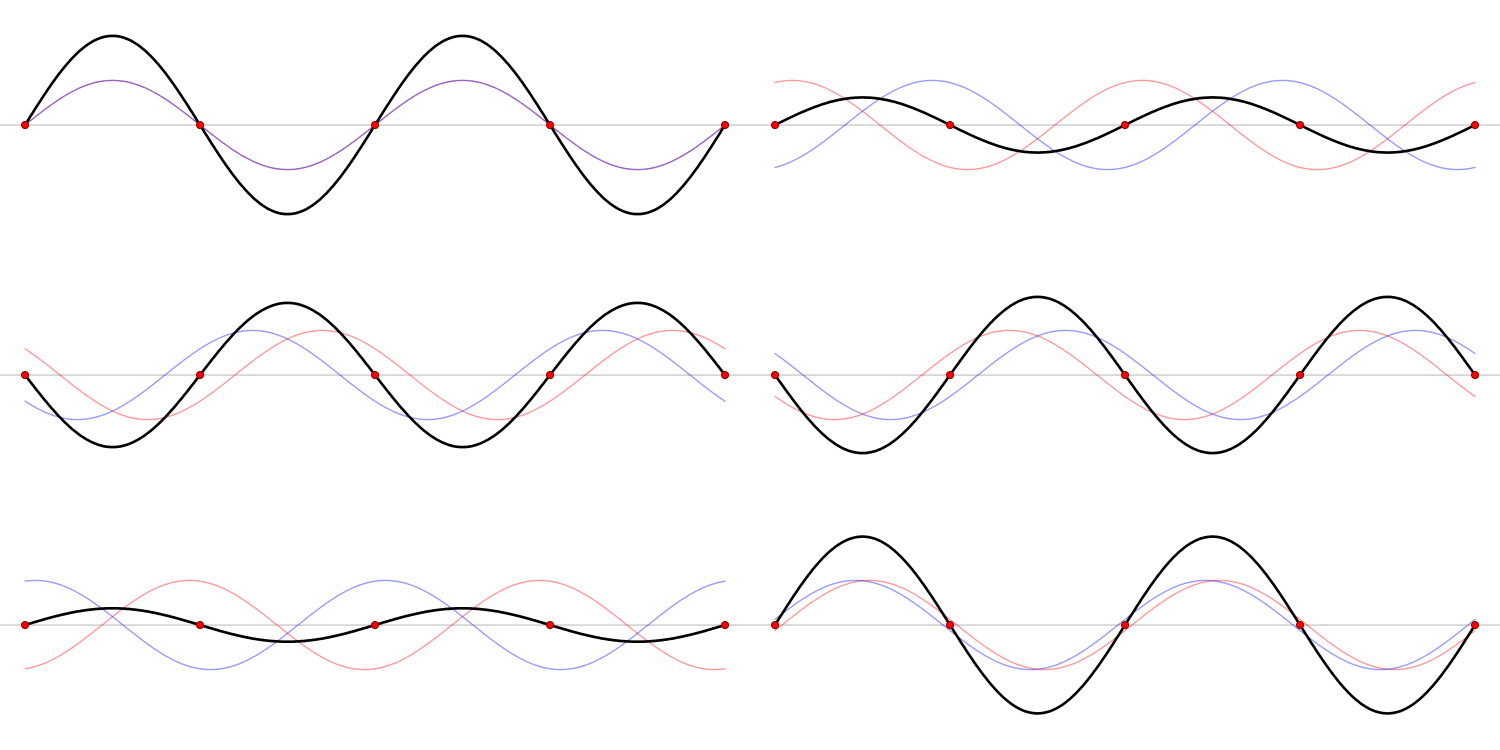
Sound waves travel along just fine until they hit a boundary.  When that happens, the waves bounce off the boundary and become reflected waves.  The initial wave, called the incident wave, can meet up with the reflected wave where the two waves interfere with one another to form a new wave that is the sum of the other two waves.  This is called the principle of superposition.  (I know I'm getting a bit redundant, but hang with me here.)  If, during superposition, two waves meet up that are completely in phase, the result is a standing wave.

As you can see above, one type of standing wave doesn't travel anywhere.  It stays in the same place constantly.  This results in areas where the displacement is zero, called nodes (shown by the red dots above), and areas of maximum displacement called antinodes (the tall peaks and valleys above).  So the constructive interference of an initial wave meeting up with a reflective wave to form a standing wave looks something like this:

The red and blue waves meet up to form the standing wave in black.  Other cool animations can be found here and here
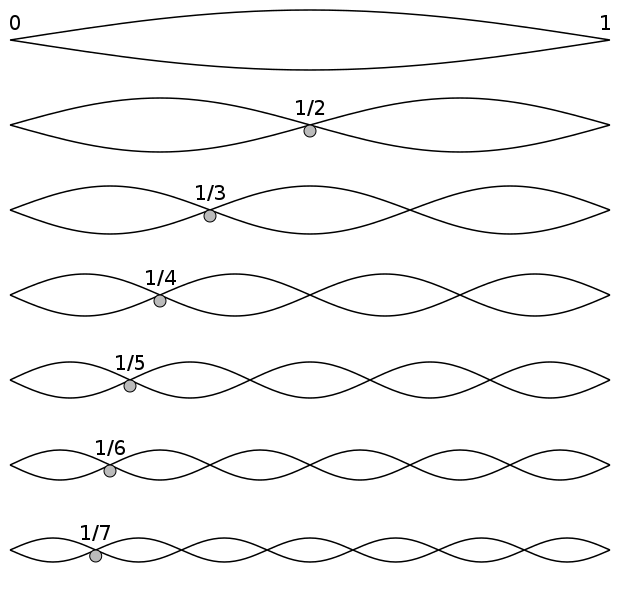
But how do standing waves that don't go anywhere contribute to a singer's resonance?  Well, that question is kinda jumping a bit farther ahead than where we are now.  For now, just think about standing waves on a medium that is fixed on both ends, like a string.  Ever played with a string or  necklace where you bounce the string up and down?  If you have, you actually formed a standing wave at the string's first resonant frequency, called the fundamental frequency.  But the string does have other frequencies it could resonant at, called overtones.
First fundamental and first six overtones of a string
But why am I talking about strings?  What do strings have to do with vocal resonance?  Think about it a second:  What acts like vibrating strings with fixed ends when we speak or sing?  Yup, the vocal folds.  But, the vocal folds vibrate in patterns that are much more complex than just a single string.  Remember how the air opens them from the bottom to the top, due to subglottal air pressure, and then the folds get sucked in laterally because of the Bernoulli effect?  The resulting wave pattern is very intricate,which results in a complex waveform (multiple simple sine waves going out at once) being produced at the level of the vocal folds.  The fundamental frequency and all of the overtones of the human voice originate at the level of the vocal folds.

*That last bit is very, very important, and it seems to be where a lot of singers get very confused...usually not due to any fault of their own.  The vocal tract absolutely cannot create sound waves or overtones to those sound waves:  Not the singer's formant, not the harmonics, not any of it.  All of the frequencies picked up by a spectrograph originate from vocal fold vibration.  The vocal tract only acts as a filter for the frequencies sent out by the vibrational pattern of the vocal folds.  And that's where we'll pick up next time!

Raphel, L. J., Borden, G. J., Harris, K. S. (2007).  Speech science primer:  Physiology, acoustics, perception of speech (5th ed.).  Philadelphia, PA:  Lippincott Williams & Williams.

Sunday, February 12, 2012

Physics of Sound Series: The Waveform (or, What the Heck am I Looking At?)

We now know that a sound wave is made up of moments of compression and rarefaction, and we know a little bit about a waveform as well.  But there are other parts to a wave that we need to know about before we get into just what resonance really is.  Those parts are:  Period, frequency, amplitude, phase, and wavelength.

No doubt, you've heard of some of these before.  Frequency and amplitude, in particular, get a lot of attention in the music world.  A lot of times, we talk about frequency and amplitude as synonymous with pitch and loudness, and for most purposes they are.  However, when I talk about frequency and amplitude, I'm going to be referring to the actual physical properties of the sound wave (or waves), meaning the parts of the wave that can be measured with proper instrumentation and then studied.  Therefore, frequency and amplitude are objective measurements.  Pitch and loudness are usually associated with the perceptual properties of the wave, i.e. just how loud or how high/low a person perceives that sound differs from person to person (and from ear to ear, for that matter); so pitch and loudness cannot be measured per se, but rather discussed subjectively.  (And remember from my previous post:  Anytime I'm talking about perception, I'm talking about the interaction from a sensory signal with a person's higher cognitive functions and life experiences.  Therefore, perception is always subjective.)

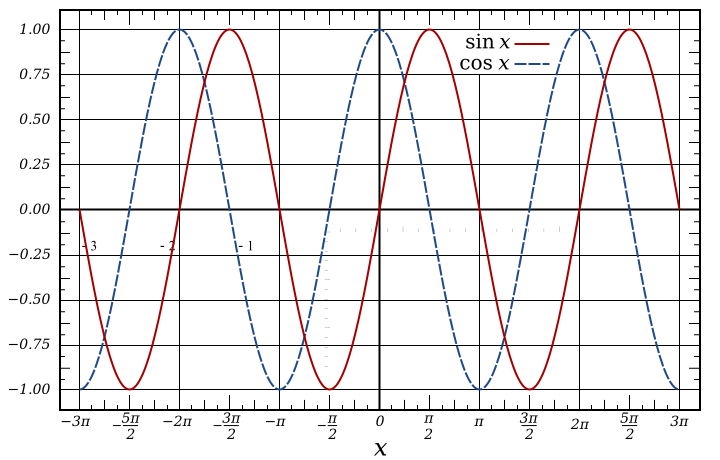
Yup, those are the same sine and cosine functions from trigonometry that you see on your calculator.
When you look at the waveform of a basic sine wave (the red line) shown above, you'll see that it has a repeating pattern.  The number of repeats of this pattern in a given amount of time is called the frequency of the wave.  This is usually given in Hertz, but can also be stated as the number of cycles per second of the wave pattern.  (See, it was originally called cycles per second (cps), but then the International Electrotechnical Commission (IEC) decided to honor Heinrich Hertz's contribution to the field of electromagnetism, so they gave him a unit of measurement, cps, and called it Hertz (Hz).  Scientists are always re-naming units to honor the great contributors to the field.  Sorta like how medical terminology is also littered with the names of big anatomy contributors, etc.)  So, for the famous A440 that orchestra's (supposedly) tune to, the frequency is 440 cycles per second, or 440 Hz.  In math terms, frequency is shown by:  frequency = velocity over wavelength (f = v/λ).  Sounds pretty fancy, but the reason I'm putting this here is because the period of a wave is related to the frequency.  The period is how long it takes for one cycle of the wave pattern to complete itself.  So if the frequency could be shown as: 1/period, then the period is shown by:  1/frequency.  Seems like we're talking about the same thing, but in general, the frequency refers to how often the wave pattern is repeating itself where the period refers to how long it takes for one pattern of the wave to complete itself.  Why do we bother with this distinction?  Well, because it comes in really handy for mathematical analysis of wave patterns.  Why should singers bother to know about this?  Because...well...I'll get there for ya.  (Besides, if your ever playing around with PRAAT or some other spectrograph software, you'll probably see options for period or frequency change, and you might want to know what you're changing out as you play around.)

Wavelength corresponds to the distance one cycle of the wave travels.  Slower frequencies have longer wavelengths, so one cycle of A440 travels double the distance through the atmosphere than A880.  (In the above equations, wavelength is represented by that funny-looking symbol, which turns out to be the Greek letter lambda.  So now, when you poke around wikipedia and see frequency equations, you'll know some of what you're looking at.)

The amplitude of a wave corresponds to it's perceptual loudness, and is related to the amount of displacement the air particles go through in the sound wave.  Because it has to do with how far each particle is being "pushed," amplitude represents the atmospheric pressure of a sound wave, and is measured in decibels (dB).  In the waveform shown above, amplitude is represented on the vertical axis.  So if the sine wave had a higher amplitude, it would have taller peeks and lower valleys, going past the 1.00 marked above.  Even though amplitude of sound is represented by this vertical displacement on the waveform, in longitudinal waves, the displacement in the real world is happening horizontally.  This is different for other wave types, like light, but the math and the graphical representations are the same.  (I just want to point that out because it's easy to misinterpret the sound waves from your mouth as looking just like the waveform representation, but if we could see the sound wave, it would like more like the animation here.  That's kinda important to remember once we get to the anatomy of the ear and the role the ear drum plays in hearing.  And, oh yeah!  I'm going to get into the anatomy of the ear and how it plays a role in resonance as well, for both the audience and the singer!)

Phase is where we start to get into some important stuff when it comes to understanding resonance, and especially the phenomenon of standing waves.  The phase of the sine wave in the above picture basically is where in the cycle the wave starts when you're looking at the vertical axis.  Let's look at it more closely:

See how the sine wave is passing through the vertical axis where the horizontal line equals 0?  Now look at the cosine wave (blue, dotted line).  Cosine is passing through that vertical axis where a horizontal line equals 1.  So the phase of the sine wave is not the same as the phase of the cosine wave.  The fancy way of saying that is that cosine has a different phase shift than sine.  In fact, that's actually the main difference between sine and cosine:  The phase shift between the two.

Phase is really, really important because if you have two sound waves that are out-of-shift like this:
Look at the three middle waves to see the phase difference.
You'll see how when one wave has a peek in its amplitude, the other wave has a valley, or a negative amplitude.  This means that when one wave is in it's period of compression, the other is in rarefaction.  The result is that these two waves actually cancel each other out, because if the atmospheric pressure is equally positive in one wave while the pressure is equally negative from the other wave, the two pressure differences cancel each other out.  1-1=0, right?  Crazy, huh?

But what happens when two sound waves are perfectly in phase?  What if you've got 1 + 1 instead of 1 -1?  That's where the phenomenon of standing waves comes in, and that's what we'll start up with next time.  Stay tuned!

Raphel, L. J., Borden, G. J., Harris, K. S. (2007).  Speech science primer:  Physiology, acoustics, perception of speech (5th ed.).  Philadelphia, PA:  Lippincott Williams & Williams.

Friday, February 10, 2012

Physics of Sound Series: The Acoustic Wave

I always have the hardest time starting up these series, because I spend a lot of time trying to figure out where to start.  I always know what the ending conclusion should be, but what's the beginning?  What's basic without being too basic?  So I'm going to start out where I think it should start out, but if I'm not being basic enough, please feel free to post any questions you may have.

Everybody always talks about resonance in the singing world.  Resonance, resonance, resonance.  Let's face it, as opera singers, we're pretty obsessed about it.  And why wouldn't we be?  It is, after all, the key to how opera singing works.  It is exactly how we are able to sing over an orchestra for hours at a time without hurting our voices.  The only issue I have with all this resonance talk is that it is painfully obvious that (some) singers have absolutely no clue what resonance really is.  It often gets talked about as a subjective thing that changes from person to person.  This is understandable given that so much of the sensation of singing is subjective, and therefore, how we teach singing is subjective.  It only makes sense that singers would start to think everything about singing is subjective somehow.  However, when we take something from the hard sciences, like resonance, and think of it as something that acts differently from person to person, as if it doesn't follow the laws of nature, we kinda sound like fools.  The other issue with all this resonance-as-subjective talk is that it makes what could be very clear pedagogy very fuzzy and confusing.  So, in order to fully understand what resonance is and how it can help us sing better, let's start with how a single sound wave works.

There are a lot of things in nature that function like waves:  Light, sound, the water in your bathtub...(okay, fine, ocean water too), but what exactly does that mean for sound to have a wave-like pattern of behavior?  Well, here's the definition of a wave from physics:  "a disturbance (an oscillation) that travels through space and time, accompanied by a transfer of energy...often with no permanent displacement of the particles of the medium (Wikipedia)."  Sounds pretty fancy, am I right?  But it does make a lot of sense.  If you drop a rock straight down into a body of still water, the rock disturbs the water's stillness causing a rippling of waves that travel out to the edges of that body of water.  Energy was transferred from the rock to the water which then traveled out to the edges of the body of water.  The water itself, though, will return to being still, i.e. it doesn't just keep traveling away from the rock until there's no water left, so there wasn't a permanent displacement of the particles of that water (you know, H2O).

So what's the "medium" for sound waves?  Air particles!  All the lovely little air particles that make up our atmosphere is the medium for all the sound waves we hear, and the ones we don't hear too (i.e. ultrasound, infrasound, etc).  For our purposes, we'll think of a sound wave as beginning with air particles at rest.  An external force then comes along and sets those particles in motion (like when the electric slide is played at a wedding...sorry, couldn't resist.)  Anyways, let's imagine those particles are all lined up nicely next to one another.  The particles in row A, the ones closest to the external force, then get "pushed" up towards the particles in row B.  This is where we say the row A particles are "compressed" against row B, which then gets pushed up against row C, and so on.  (Anyone who's ever seen elementary-school kids line up for recess knows what I'm talking about here.)  So while each row is going into it's period of compression with the particles in front of it, the rows that have already been compressed then go into a period of rarefaction.  This would be when row A, after compressing with row B, swings back towards it's resting position.  But instead of landing at rest, row A actually over-shoots its resting position and ends up being spaced out farther from the row B particles.  If we want to get even more specific here, the property of inertia for those particles causes row A to compress with row B, then the property of elasticity over-takes row A's inertia, sending the particles back towards resting.  However, the property of inertia for that row of particles then over-takes elasticity and causes row A to over-shoot it's resting position.  But, don't fear, cause elasticity will over-take inertia and send row A back to towards resting.  This process will repeat itself until row A is again completely at rest.  Sounds complicated, but if you've ever set a pendulum into motion and watched until it came to rest again, you've seen this same action at work.  (*Edit to add:  This pattern of motion is called simple harmonic motion and is actually what pretty much everything in nature can be reduced to.)

This pattern of compression and rarefaction makes up what we call the sound wave.  This is why sound waves are sometimes called compression waves, but more commonly, they are called longitudinal waves.  (If you clicked on the link I had above on "compressed," you probably saw that coming.)  I encourage you to go ahead over to the link for longitudinal waves, because there are some very nice animations over there for you to see these waves in action.

One last thing before I sign off:  This pattern of compression and rarefaction is often graphically represented as a waveform.  Typically, waveforms are set on a typical Cartesian coordinate system (the graphs with x and y from math class), with the y, or vertical, axis representing the amount of displacement, which also happens to be the amplitude of the sound wave, and the horizontal axis representing the amount of time the wave has traveled.  We'll go over this all a bit more later, but I wanted to introduce it here for you just to get you more familiar with the terminology I'll be using.

Raphel, L. J., Borden, G. J., Harris, K. S. (2007).  Speech science primer:  Physiology, acoustics, perception of speech (5th ed.).  Philadelphia, PA:  Lippincott Williams & Williams.

Wednesday, January 11, 2012

Physics of Sound Series (Part I): Why do I need to know this stuff?

Because the necessity to resonant over the sound of an orchestra is dependent on vocal tract, and therefore resonance, adjustments.  However, many singers either do not understand resonance, formants, or harmonics well enough, or don't understand how physics relates to physiology well enough, that many misconceptions develop that can greatly hinder vocal progress during training.

Now, I don't mean to generalize, but I do know a lot of singers who roll their eyes at words like "physics" and "math."  In fact, I have had so, so many conversations with musicians about these topics now that I'm taking math and physics courses.  They usually go something like this:  "I can't meet then because my physics class is at that time.  Can you do Monday?"  "Physics?  Why on Earth are you taking Physics?"  "Well, I want to have more detailed knowledge of how the physics of sound and air pressures work so I can understand certain areas of SLP research better."  "Well, good for you.  I know I would never take those classes.  My brain just doesn't work that way."  It is that last sentence that I take the most issue with.  Why, oh why do we as musicians have to demean ourselves when it comes to the potential our brains have to understand something?  Do we even realize the message we're sending out?  I mean, we are the people who learn multiple languages for our roles, we learn some anatomy and physiology of the voice, and we are supposed to have at least some foundational knowledge in harmonics and formants when it comes to resonance.  This is all in addition to music theory, history, performance practice, etc.  Why do we pass off math and physics like it's "over our heads?"  Or maybe we want the world to recognize that we're plenty smart in our own right and should be respected for that (which is true).  Maybe we think that in order for our field to be respected as art we have to separate so thoroughly from science that we must turn our noses up at it.  Maybe we're sick of people in the sciences turning their noses up at us...(I know I'm sick of that).  Maybe we don't want to have to add more stuff to our already extensive list of stuff to know.  Either way, I do wish my fellow musicians would stop looking at me like I've grown a second head when I say I'm enjoying learning calculus and calculus-based physics.  But I digress...

Perhaps most of the issues with math and physics for singers, or just most people in general, comes from the fact that these subjects are very rarely taught well in high school (in the US,) and even in college, for that matter.  Much of the time, teachers in these subjects see the class as some sort of grand IQ test in which student's successes or failures have no bearing on the teacher's ability, or inability, to effectively teach the material.  That's a common fallacy of certain hard-science classes.  (Personally, I liked my calculus's professors take on it:  Success in her class, as far as she was concerned, was totally up to the student's dedication and motivation to keep up with the homework (practice) and get help when needed.)  So we've relegated the teaching of these concepts to a month or so during a vocal pedagogy class.  But maybe, just maybe, voice teachers trying to teach these concepts don't quite give the right amount of time or clarity to these concepts either.  I mean, if you're knowledge doesn't have a strong foundation, it is really easy to get confused when, a few years after your pedagogy class, you've been swamped with new information, new ideas, new research, new teachers, new coaches, etc.  I know I did!

I thought I got plenty of this stuff in my vocal ped. courses.  I thought I had a very good understanding of harmonics, resonance, formants, etc. because I was one of the few in my pedagogy class that was not confused by the lectures or book chapters on it.  I now know I was mistaken.  My mistake came from not having enough of a base-level of understanding in physics to be able to apply these concepts effectively to understanding my own vocal training, and to not get confused a year or two down the road.  There is a huge interaction between the physiology of the voice and how the physics of vocal resonance, as well as the physics of air pressure to breath support, work.  Those connections were simply missing from my pedagogy classes, and, from what I can gather from other conversations with singers, I think it's missing from many singers' academic training as well.

I had such simple misconceptions that I would be embarrassed to admit to in front of anyone with basic physics knowledge, now that I know better.  I see a lot of musicians saying some of these same misconceptions quite frequently, and I really, really want us to stop sounding like complete fools in regards to basic math and basic physics to a large portion of the general population (and not just those in hard sciences, either).  And I know a lot of singers who would really, really like to not sound like fools, but it's just never been explained well enough, or thoroughly enough, to avoid it.  Even if your interest in this might just be cursory, a more thorough understanding of the physics-physiology connection really does help to understand the science behind how the voice, and operatic singing, works and how to apply that knowledge to long-term training.  


So here's how this series is going to work:  I'm not going to get all up in calculus, cause I'm not interested in making this a math course, but I will present some basic algebraic equations.  I will also thoroughly explain these equations so that you can see how the equation is a working representation of how your vocal tract shapes sound.  We'll start with the basics and move up from there, but I'm also going to do my best to detail the interaction between physics and physiology...even if I can't get to that interaction until I get a little further down the series.  If you've ever been confused looking at a spectrogram of your singing, like in PRAAT, then this series should help you out a lot.  It shouldn't be as long as the anatomy and physiology series, so I hope you can hang in here with me.  And ultimately, just like the A&P series, I want this to be a reference tool for singers and teachers to be used whenever you need it.

Tuesday, January 10, 2012

Sensation vs. Perception: The crux of pedagogical contradictions

Just like Martin Luther King, Jr.,* I have a dream that one day vocal pedagogs will have field-specific, unified terminology that will eliminate the pedagogical confusion so many students experience when moving from one teacher to the next.  However, I'm starting to think this dream is too lofty.  In the subjective field of vocal training, trying to unify the centuries of pedagaogical terminology with the current science of voice might be a little too much of a hurdle to overcome.  I mean, motivated voice students will still desire to read and understand the writings of Lamperti, Garcia, etc. in the context of current voice training, so a complete shift toward unification might alienate the past writings of great pedagogs.

So what are we new pedagogs/voice students supposed to do?  How are we supposed to wade through the old information and understand it in terms of the new?  I think one piece of the puzzle might be to understand the differences between perception and sensation.

I touched a bit on this near the end of my previous post where I talk about what I feel is happening when I am singing, but it is something I've incorporated into my teaching that, I think, many of my students, even the teenagers, seem to appreciate.  One of my high school students had one of her choir teachers give her a few "vocal tips" that seemed to confuse her in terms of what we had been working on in her lesson.  Using this established difference between sensation and perception, I was able to explain rather quickly to this student that we were, in fact, working on those things, we were just calling it something different in our lessons.  This difference has become such an easy way for my students to begin developing a "tranlation" ability, which I find so, so important, since I know for most of them, I will not be their only voice teacher throughout their training.

What is sensation and what is perception?  Sensation is a term used in psychology, as well as anatomy and physiology, to refer to sensory information from the outside world coming into our bodies via the nervous system.  When this information reaches your brain, it processes this information, associates it with memories, etc. through some cognitive processing, and then decides how to act.  This is the process of perception, which happens to be a very individual process.  So sensation (diff. link) is the incoming information, and perception is the interpretation of that incoming information.  This works all the time for all of us in some obvious ways:  If two friends go to see the same movie, both people receive the same incoming information, i.e. the movie, but they might interpret the "take home message" of the movie in two different ways via their individual perceptions.  (How many of us have sent friends articles, etc. where the friend seemed to miss what was, to us, the vital underlying point of the article?  You can now blame their perception for getting it wrong...or yours, if you're humble like that.)

How does this work for pedagogy?  Well, a lot of the differences we encounter in pedagogical terms comes from the vast differences in the perception of proper singing...at least as far as I perceive it.  (Yikes!  This article could quickly become an exercise in circular logic, couldn't it?)  For example:  So much debate has been waged over the "low larynx" issue.  Student 1:  My teacher said my larynx should never move while singing.  Is this right?  Student 2:  Well, my teacher said research has shown that it does move quite a lot and should raise on high notes, so I guess you're teacher is wrong.  Student 1:  But my teacher said historical documents all talk about the importance of a lowered larynx, so are all those singers of the past wrong?  And the debate rages on.  So what's going on here?  How can science point to the opposite of what all the great singers and past teachers say they're doing?  Sensation and perception!  Biologically, the larynx is certainly moving around during singing, and yes, it is raising on high notes.  It's a physics-thing that simply must happen.  However, when laryngeal efficiency has been obtained, the singer feels like their larynx isn't moving at all and the teacher might not see the larynx raising as much in the throat as it used to.  So the singer might perceive that their larynx is stable, but it's just due to how their brain interprets the sensation of laryngeal efficiency throughout their range.

Another example:  #1:  The ribcage must stay elevated and stable!  #2:  The ribcage collapses during exhalation out of necessity since the lungs are getting smaller!  #1:  You're wrong!  Here's a youtube video.  #2:  No, you're wrong!  Here's an article by "Prominent Scientist."  How does sensation and perception help explain this one?  Well, the fact that the chest cavity decreases in size during any exhalation can not be argued.  It's another physics-thing that simply must occur.  But why would so many singers swear up and down that their rib cage is as stable as stable can be and always elevated during singing?  Sensation and perception!  The act of using excess muscular effort to keep the rib cage from lowering too fast sends very different sensation information to the brain than what it's used to.  For most people, the brain interprets this information with the perception that the rib cage is not moving at all, perhaps because the information is so opposite of what the brain is usually getting about the movement of the rib cage.  So you end up with a lot of singers and teachers swearing up and down that the rib cage must not move, when in fact, it must move, but it must move so much more slowly than usual that it feels like it's not moving at all.

I'm sure there are other examples out there, but I cannot think of any at the moment.  If you have had a similar debate about another important pedagogical concept, please let me know.  I'll see if I can answer it using this sensation/perception model of explanation for ya!


*Disclaimer:  This is a dry-humor joke equating my tiny, little dream of unified pedagogical terms to the great deeds accomplished by Dr. King during his lifetime.  I'm pretty much an ant on the mountain of his greatness as far as I'm concerned.  I've just been watching too many 30 Rock reruns to resist the joke. **
**Disclaimer for the disclaimer:  I find dry-humor doesn't always come across online so I felt the need for disclaimer #1.  However, upon reading the over-explanation of the joke in disclaimer #1, I realize the already bad original joke has now been effectively destroyed.  Awesome.

Thursday, October 20, 2011

Anatomy and Physiology series: Applying the concepts to singing (a summary)

I believe the end-goal of operatic training is to resonate the voice over the sound of the orchestra while having the technical freedom to effectively meet the musical demands and communicate with the audience for however many hours long the performance is.  (Luckily for us, technical freedom and resonating over an orchestra are not mutually exclusive.)  Although many singers are able to accomplish this, I believe keeping up to date on vocal science can make vocal training more effective, thereby allowing motivated singers to accomplish this goal in a shorter period of time than our current model of training.  (Especially since the days of intense, one-on-one training with voice teachers multiple days a week are probably not coming back…at least in the US.) 

We should be taking already built-in biological functions:  using muscles of inhalation during the checking action (or appoggio), it’s relationship to adjustments of medial compression to air flow, neurologicalconstructs of articulation, and a basic understanding of the relationship of some cognitive process to motor control can help teachers to stream-line their training and can help students to better monitor their technique when out on the professional performance circuit.  Bel canto technique did not develop in a bubble, nor where those old master’s of singing granted some great vocal wisdom that was lost to history.  So how did they develop this technique?  I hypothesize that healthy singing technique was developed to meet the vocal demands of the opera house and increasing orchestral size by observing and building upon the already-existing healthy function of the human voice.  (Just as any Olympic athlete builds on the body's natural abilities while training to do amazing things.)

Much of the healthy coordination, the minute adjustments our body makes throughout our day, happen in the background of our consciousness.  To train, we must bring some conscious awareness to the adjustments required, but once the proper coordination is in place, we must remove it from our consciousness once again.  When I took vocal pedagogy classes, the function of the brain and nervous system was never mentioned.  What a fallacy in training future teachers to leave out the “boss” of the whole system!  The great pedagogs of the past cannot be blamed for this.  The greatest discoveries into the functioning of the brain are rather new thanks to improved imaginging technology.  The fault is our own for thinking the pedagogs of the past offered all the information we needed to know.  I don't believe those great pedagogs ever intended for their work to be the end-point, I believe they wanted it to be a beginning:  A beginning of continued discovery between voice science and voice teachers.  (But enough of my rant.)  

There are neurological constructs that aid in healthy vocal production:  checking action, articulation, etc., and there are some that counteract healthy vocal production:  engaging pharyngeal constrictors, contractingthe abdominals while singing, etc.  This is why it would be equally important for voice teachers to also be aware of biological relationships that counteract proper singing, such as the rigid support system which involves abdominal contraction and laryngeal closure.  Eliciting that response by making the abdominals rigid might initially produce an impressive sound, but is asking for vocal trouble down the line.

I’m going to get into some posts on the physics of resonance, but for now, just remember that the way to maximize vocal resonance is by maximizing space in the vocal tract.  However, space in the vocal tract is not maximized by trying to create space.  Rather, it is maximized when the entire vocal system is functioning efficiently.  The kicker is:  When it is functioning efficiently, there isn’t a sensation of “work” being done by the throat or articulatory system, you actually feel nothing happening in the throat.  In fact, the little bit of sensory feedback we get from the laryngeal area is only there to tell our brain when something isn’t right…so if you feel something adjusting in your throat while singing, it more than likely is a sign of tension.  Healthy production feels like “doing nothing,” or feels “as easy as speaking” (if you have a healthy, unstrained speaking voice).  Indeed, the only direct sensations most high-level singers talk about feeling are either sensations of resonance or sensations in their “breath support” system (i.e. ribcage, upper back, lower back, etc.).

So here's a summary of what re-learning to sing seemed like to me after learning all of this stuff:  When my checking action (or appoggio) is engaged, I feel a sensation of my ribcage staying elevated.  To do this, I consciously think in opposites:  I think of making my ribcage larger and larger as the air is going out.  The result is a slow, but consistent, exhalation.  Because air is going out, my ribcage is going down, I just don’t have a sensation of it going down.  Because of the neurological connection of the checking action to medial compression, I don’t feel anything happening in my larynx at all as long as the checking action is engaged.  But must be engaged constantly while I sing, in every part of my range and at the end of every phrase going into my next inhale.  This is the closest thing to straight-up strength training a singer will do, because maintaining contraction of the muscles of inhalation is very tiring to those muscles at first, which is why I would suggest practicing it in short bursts at first:  5 full minutes for a few days, going to 10 full minutes, to 15, and so on.  And remember, the muscles of inhalation are more than just the intercostals, which might be why some people feel it in their upper back, some near the lower ribs, some feel it near their sternum.  I don't think any of those sensations are wrong as long as the result, i.e. free vocal production, is present.  (What was difficult for me, though, was training to feel the sensation of the checking action throughout my range…even all the way up and down fast-moving scale, or during large jumps from low to high to low again, so it might take a little "play time" with this concept to accomplish it consistently.)  If I obsess too much about any part of my articulatory system, I personally start to feel strain near the root of my tongue, so what I do is pause, speak through the text, and then sing through it with the idea that everything above the larynx is just “talking” the text.  That tends to free up the resonance and tongue for me right away.  There is more to my current technique than just that, but these are the main concepts from physiology that I apply consistently in my singing and my teaching.

As a teacher, I see the biggest gains early on in my student's training once we train in the checking action throughout the range.  The exhalation will increase as a person goes up the scale, but maintaining the sensation of resisting exhalation, even as exhalation increases, really opens everything up...once it is attained.  It takes a while for folks to get used to thinking in opposites like that, but think of it like a yin and yang, two opposing ideas sometimes allows you to find the proper balance.  (Oh, and always remember that biologically, the larynx is a valve, so if you throw too much air at it, the valve will close off to try to control that airflow.  And closing off the valve gets the pharyngeal constrictors involved, which results in a "pushed" vocal production.)

So there is, of course, a little more to it than what I outlined there, but that gives some idea of how these concepts from anatomy and physiology of the whole communication system can be applied to singing.  I think I covered everything, but if you've got any questions, please feel free to post them.  I might have accidentally left something vital out.

Continuing on, I’m going to write more on the physics behind the resonance of our voice, and I’m going to go a bit into the ear and why we hear our voice the way we hear it…and also why “not listening to yourself” seems like such an impossible concept for so many beginning singers; the answer to that might just surprise you.