It will always take courage to dramatically change the plan you originally had for your life and career. Leaving what you know and stepping into the unknown, especially not knowing if you'll succeed, is a scary thing.
I'm not gonna lie, when I told my friends and family that I was making this career change from professional-ish singer to SLP, most people were crazy happy about it. My mom was happy because she had always seen my love for medicine and science, so I think she was happy I was going more in that direction. But a lot of other folks I met always thought of one thing: The money. The SLP field has plenty of job openings, even in this tough economy, so it's a stable future career...unlike singing, obviously. So that must be why I was doing it, right? I mean, vocal injury...blah blah blah, but part of me must like the good job prospects, right? Okay, well, I would be lying if I said the potential for a good, stable job isn't appealing. Of course it is! But changing from singer to voice scientist brought a different thought of myself: Quitter.
Singing is what I know. Training to be a singer is what I put years and years of effort and put *mumble mumble* amount of money into. Making a career change after over a decade of musical training made me feel like a big, fat quitter. I mean, I had finally gotten my voice back in working order! I was finally able to make a professionally-viable sound! I finally had something to offer the musical world! How could I just quit after all of my struggles? How could I just hang up my hat when I finally had a chance to be competitive in the performance circuit?
The truth is, I didn't give it up quickly. As I started my classes for the SLP undergraduate leveling courses, I figured I'd be able to do professional singing on the side of being an SLP, no problem. I kinda thought of SLP as a totally awesome supplement to my singing career. I still practiced everyday. I still intended to do this particular state voice competition that year, and I still intended to audition for summer shows and YAPS. But very shortly after staring my classes, my goals in the SLP field began to readjust, I began to totally fall in love with the field, I started to desire a PhD after the master's degree, and I realized I had to start giving up some of those dual-career dreams of mine.
The breaking point came when the application deadline for that state competition was approaching. I went to my voice teacher for a lesson knowing I'd need to really bust my a** over the next two months to get into competition shape since I had not been getting regular coachings in while in school. I had a good friend of mine, also a singer, who was really excited for me to do the competition. He was convinced that I would place very highly (which I doubted very much), but at the least, he felt I would finally be able to show all those folks who knew me "pre-therapy" what my voice could "really do"...now that it was healed up. (Remember, I had this injury for probably about ten years before my diagnosis...including during all of my master's of music program.) My teacher, though, felt I had too much on my plate already, so she suggested I not do the competition. Being the great teacher she is, she recognized that I wasn't totally in the performance-career-mode anymore, and busting yourself to compete in something that you're just not that into is exhausting and rather pointless when you already have a lot going on. So, just like the lesson when she suggested I look into SLP as a career, I left that lesson thinking about what she said, and I realized she was right, I probably shouldn't sign up.
When I got home, I looked over my class schedule and realized the competition date was the same week as three of my mid-terms, and two major projects were due that week as well. And what I had already discovered from my first semester in SLP, being in a non-music major yields very little time to practice music at all. See, it's hard just keeping your voice in shape if you're not in music school or performing, cause you have to make time just to sing everyday. As a voice student, though, you sing everyday anyway. So even if you're not practicing your own rep., at least your instrument is staying in tip-top shape. I'd have to work double-time to not only get my rep. up to snuff, but also just to keep my voice in good shape day-in and day-out...and there's no way I'd be able to do all of that on the side of studying for three mid-terms, completing three projects, and maintaining a full studio of voice students. It was too much, and I had to give up the idea of singing at the competition.
What I realized the most through all of this was that my more-latent vocal science passion was very quickly over-riding what had been my dominant passion of performing. I felt a bit depressed letting go of those performance dreams, and I felt like I was letting myself, and all the people who supported my singing, down. I really felt like I was morning the loss of "performance me."
The truth is, anytime someone chooses to leave behind the world he/she knows and the dreams he's/she's been following for years to enter into the unknown there is an inherent morning period for the dreams that are being lost in the transition. You have to grieve for those dreams, let go of the guilt, and walk into the unknown, which, despite possible job prospects in any field, is a scary place to venture, for anyone. When someone leaves a lucrative profession to follow a dream of a career in the world of performance, they are applauded for being so courageous. But I say that anyone who leaves the world of performance for a different dream of a potentially lucrative career is still just as courageous. It's leaving the known for the unknown and not getting stuck in morning for what you're giving up. It's going through a tough emotional journey to hopefully come out better on the other side. That takes courage. So for anyone out there making this transition out of the performance world, just know that, while it sucks at first, you're no more of a quitter than that "accidental tenor" guy is...and you're just as brave in my book.
And I must say, I really am enjoying singing and music more now that it's not a job to me anymore. The joy is back, and it's heightened by having enough vocal freedom to really express the music...unlike back in high school. Being a high-quality avocational singer is very liberating, once you embrace it as your new place in the music world.
Update in Sept. 2015: I posted a couple of short practice sessions of my singing on a new post recently. My professional-brain is saying I'm being gutsy just throwing out less-than-perfect singing, but my avocational-brain is saying, "Heck, why not?! If it sucks too bad, it doesn't really actually affect my professional life anymore, so just go for it anyway."

New Voice, New Career
Thursday, October 20, 2011

Anatomy and Physiology series: Applying the concepts to singing (a summary)
I believe the end-goal of operatic training is to resonate the voice over the sound of the orchestra while having the technical freedom to effectively meet the musical demands and communicate with the audience for however many hours long the performance is. (Luckily for us, technical freedom and resonating over an orchestra are not mutually exclusive.) Although many singers are able to accomplish this, I believe keeping up to date on vocal science can make vocal training more effective, thereby allowing motivated singers to accomplish this goal in a shorter period of time than our current model of training. (Especially since the days of intense, one-on-one training with voice teachers multiple days a week are probably not coming back…at least in the US.)
We should be taking already built-in biological functions: using muscles of inhalation during the checking action (or appoggio), it’s relationship to adjustments of medial compression to air flow, neurologicalconstructs of articulation, and a basic understanding of the relationship of some cognitive process to motor control can help teachers to stream-line their training and can help students to better monitor their technique when out on the professional performance circuit. Bel canto technique did not develop in a bubble, nor where those old master’s of singing granted some great vocal wisdom that was lost to history. So how did they develop this technique? I hypothesize that healthy singing technique was developed to meet the vocal demands of the opera house and increasing orchestral size by observing and building upon the already-existing healthy function of the human voice. (Just as any Olympic athlete builds on the body's natural abilities while training to do amazing things.)
Much of the healthy coordination, the minute adjustments our body makes throughout our day, happen in the background of our consciousness. To train, we must bring some conscious awareness to the adjustments required, but once the proper coordination is in place, we must remove it from our consciousness once again. When I took vocal pedagogy classes, the function of the brain and nervous system was never mentioned. What a fallacy in training future teachers to leave out the “boss” of the whole system! The great pedagogs of the past cannot be blamed for this. The greatest discoveries into the functioning of the brain are rather new thanks to improved imaginging technology. The fault is our own for thinking the pedagogs of the past offered all the information we needed to know. I don't believe those great pedagogs ever intended for their work to be the end-point, I believe they wanted it to be a beginning: A beginning of continued discovery between voice science and voice teachers. (But enough of my rant.)
There are neurological constructs that aid in healthy vocal production: checking action, articulation, etc., and there are some that counteract healthy vocal production: engaging pharyngeal constrictors, contractingthe abdominals while singing, etc. This is why it would be equally important for voice teachers to also be aware of biological relationships that counteract proper singing, such as the rigid support system which involves abdominal contraction and laryngeal closure. Eliciting that response by making the abdominals rigid might initially produce an impressive sound, but is asking for vocal trouble down the line.
I’m going to get into some posts on the physics of resonance, but for now, just remember that the way to maximize vocal resonance is by maximizing space in the vocal tract. However, space in the vocal tract is not maximized by trying to create space. Rather, it is maximized when the entire vocal system is functioning efficiently. The kicker is: When it is functioning efficiently, there isn’t a sensation of “work” being done by the throat or articulatory system, you actually feel nothing happening in the throat. In fact, the little bit of sensory feedback we get from the laryngeal area is only there to tell our brain when something isn’t right…so if you feel something adjusting in your throat while singing, it more than likely is a sign of tension. Healthy production feels like “doing nothing,” or feels “as easy as speaking” (if you have a healthy, unstrained speaking voice). Indeed, the only direct sensations most high-level singers talk about feeling are either sensations of resonance or sensations in their “breath support” system (i.e. ribcage, upper back, lower back, etc.).
So here's a summary of what re-learning to sing seemed like to me after learning all of this stuff: When my checking action (or appoggio) is engaged, I feel a sensation of my ribcage staying elevated. To do this, I consciously think in opposites: I think of making my ribcage larger and larger as the air is going out. The result is a slow, but consistent, exhalation. Because air is going out, my ribcage is going down, I just don’t have a sensation of it going down. Because of the neurological connection of the checking action to medial compression, I don’t feel anything happening in my larynx at all as long as the checking action is engaged. But must be engaged constantly while I sing, in every part of my range and at the end of every phrase going into my next inhale. This is the closest thing to straight-up strength training a singer will do, because maintaining contraction of the muscles of inhalation is very tiring to those muscles at first, which is why I would suggest practicing it in short bursts at first: 5 full minutes for a few days, going to 10 full minutes, to 15, and so on. And remember, the muscles of inhalation are more than just the intercostals, which might be why some people feel it in their upper back, some near the lower ribs, some feel it near their sternum. I don't think any of those sensations are wrong as long as the result, i.e. free vocal production, is present. (What was difficult for me, though, was training to feel the sensation of the checking action throughout my range…even all the way up and down fast-moving scale, or during large jumps from low to high to low again, so it might take a little "play time" with this concept to accomplish it consistently.) If I obsess too much about any part of my articulatory system, I personally start to feel strain near the root of my tongue, so what I do is pause, speak through the text, and then sing through it with the idea that everything above the larynx is just “talking” the text. That tends to free up the resonance and tongue for me right away. There is more to my current technique than just that, but these are the main concepts from physiology that I apply consistently in my singing and my teaching.
As a teacher, I see the biggest gains early on in my student's training once we train in the checking action throughout the range. The exhalation will increase as a person goes up the scale, but maintaining the sensation of resisting exhalation, even as exhalation increases, really opens everything up...once it is attained. It takes a while for folks to get used to thinking in opposites like that, but think of it like a yin and yang, two opposing ideas sometimes allows you to find the proper balance. (Oh, and always remember that biologically, the larynx is a valve, so if you throw too much air at it, the valve will close off to try to control that airflow. And closing off the valve gets the pharyngeal constrictors involved, which results in a "pushed" vocal production.)
So there is, of course, a little more to it than what I outlined there, but that gives some idea of how these concepts from anatomy and physiology of the whole communication system can be applied to singing. I think I covered everything, but if you've got any questions, please feel free to post them. I might have accidentally left something vital out.
Continuing on, I’m going to write more on the physics behind the resonance of our voice, and I’m going to go a bit into the ear and why we hear our voice the way we hear it…and also why “not listening to yourself” seems like such an impossible concept for so many beginning singers; the answer to that might just surprise you.
Continuing on, I’m going to write more on the physics behind the resonance of our voice, and I’m going to go a bit into the ear and why we hear our voice the way we hear it…and also why “not listening to yourself” seems like such an impossible concept for so many beginning singers; the answer to that might just surprise you.
Friday, October 7, 2011
Anatomy and Physiology series: Physiology of Articulation
The physiology of articulation is an incredibly complex act...which is why I felt it necessary to go through the posts on the nervous system first before I attempted to explain any of what we know about it.
To refresh, we're talking about all the muscles of articulation, from the soft palate, to the tongue, to the muscles of the jaw, to the facial muscles. I thought about counting how many muscles are involved here, but I decided to be lazy and so I didn't...but there are a lot of them. When you produce a phoneme, or smallest sound in a language (think IPA symbols), your articulators are creating the appropriate, corresponding shape for your vocal tract in relation to that sound. When you move on to the next sound in a word, the articulators are moving to the position that corresponds to that second sound. Now add to that the knowledge that we speak an average rate of 10+ phonemes per second (in Standard American English...most other spoken languages are actually faster), and you start to get some idea of how rapidly and precisely these articulatory muscles have to move for someone to produce intelligible, fluent speech.
Here's the real deal with how we are able to produce such rapid, fine-tuned movement for speech: We don't really know. Sigh. But we do know a few things about how it works: We use sensory feedback from our muscles and auditory system to learn how to articulate speech in any language. We also use this sensory feedback to correct our errors in production as well (like if you ever found yourself saying "sable" instead of "table," you probably caught it and corrected yourself). And motor coordination for the whole act typically happens behind our conscious thought processes in our brain, although it does respond to what we are consciously thinking about (see this post.)
When it comes to the motor-planning aspect of speech, things get a bit muddy. There are theories that hypothesize that the command for motor-movement comes directly out of linguistic needs; meaning, we coordinate speech in order to communicate something. Other theories, called dynamic theories, say it's controlled by a series of movements comprising of a system which would work in succession to bring about the articulatory goals.
The current thinking lies somewhere in between those two theory ideas. The idea is that there are underlying neurological coordinations that control articulation in speech and that there are separate coordinations that control the articulators during non-speech tasks (such as chewing, swallow, and making nonsense sounds). Much of the evidence for this stems from brain scans and also from the failure of certain therapeutic exercises to work with disordered speech. See, there used to be a lot of "strength training" exercises for articulation that involved improving muscle tone and flexibility...or so it was thought. It was believed that these exercises, which are comprised of many, sometimes strange, non-speech tasks and non-speech sounds (some of which crept into the acting and singing world), would help teach children with disordered speech to make the correct sounds. The failure of these exercises came from two things: Most disordered speech is not from lack of muscle tone (and ones that are need can't actually do these exercises anyway) and proper execution of non-speech tasks does not generalize to speech-tasks. So what does that mean? If a child or adult with disordered speech needs to improve their speech for the purpose of communicating, then they need to practice meaningful speech.* This is why there's a lot of research going into understanding these coordinations better, if we know what's going on in a normal system then we'll better know how to treat a disordered system. (We've got some good treatments out there already, but the SLP world is always looking for ways to make their treatments more effective and more efficient...exactly what good voice teachers do in a non-scientific-stuck-in-the-lab-for-years kind of way.)
What does this mean for the singer? Well, a lot of what I will say here is my hypothesis, but I will say that, based on my own experience with re-learning how to sing as well as experiences teaching these concepts, I think I'm on the right track. I hypothesize that the articulatory system works best when it is left to function outside conscious thought as much as possible whether speaking or singing (at least in the case of a healthy-functioning system). Therefore, in order to best train the articulatory system for singing, one needs to train with meaningful speech/communication. Obviously, vocalizations can be hard to accommodate this, but it seems that when singers think more about communicating something than about making the perfect vowel or sound, then they feel a freedom in the articulatory system automatically. (And this can work on vocalizations as well: If I think of making meaningful, musical phrases out of my vocalizations then my articulators don't add unnecessary strain, even when sustaining a single vowel for a long time.) I believe this is due to the underlying coordination for communication, which would be the built-in, most efficient way to articulate anyway.
How many of us have had the effect of feeling more vocal freedom once we were told to focus on our expression of the text while we sing instead of on how we sound? And equally, how many of us experienced freedom with our diction in a foreign language after being told to speak it with the proper accent and then sing it? (And for that matter: How many variances are there in articulatory movements among the legendary opera singers of the past century?) Although the specific reason for this is still a mystery, I believe the answer lies with how our nervous system already has a built-in system for communicating with our articulators. We don't usually put our articulators under conscious control in everyday speech, and so if we put them under too much conscious control during singing the system becomes inefficient. (Like how if you're asked to do someone else's job for a day you'd be much less efficient at that job than that other person.)
How many of us have had the effect of feeling more vocal freedom once we were told to focus on our expression of the text while we sing instead of on how we sound? And equally, how many of us experienced freedom with our diction in a foreign language after being told to speak it with the proper accent and then sing it? (And for that matter: How many variances are there in articulatory movements among the legendary opera singers of the past century?) Although the specific reason for this is still a mystery, I believe the answer lies with how our nervous system already has a built-in system for communicating with our articulators. We don't usually put our articulators under conscious control in everyday speech, and so if we put them under too much conscious control during singing the system becomes inefficient. (Like how if you're asked to do someone else's job for a day you'd be much less efficient at that job than that other person.)
That's not to say that they must be under conscious control during some part of our training. Studies have shown that the brain of professional opera singers do show heightened sensorimotor, prefrontal cortex, and fine motor control activity during singing*; and most training that involves changes to brain activity must be put under conscious control at some point (usually near the beginning of learning a new task). All I'm saying is our timeline in training is often wrong. If we train our articulatory system to function efficiently in all the languages we must sing in through speech first, the result is often an efficient system within a few weeks to months, rather than years. (And if the articulation system isn't free when singing, but is unstrained during speech, then it's usually an issue with compromised laryngeal function rather than the articulatory system itself.)
So up next, I'm going to bring all this A&P stuff together with my current ideas on technique and how current voice science can be applied to learning how to sing. And if you have any questions, please feel free to post below. I'll do my best to answer them.
So up next, I'm going to bring all this A&P stuff together with my current ideas on technique and how current voice science can be applied to learning how to sing. And if you have any questions, please feel free to post below. I'll do my best to answer them.
*Seikel, J. A., King, D. W., & Drumright, D. G. (2010). Anatomy and physiology for speech, language, and hearing. Clifton Park, NY: Delmar.
*Bunton, Kate. (2008). Speech versus nonspeech: Different tasks, different neural organization. Seminars in Speech and Language, 29(4), 267-275.
*Kleber, B., Veit, R., Birbaumer, N., Gruzelier, J., Lotze, M. The brain of opera singers: experience-dependent changes in functional activation. Cerebral Cortex, 20(5), 1144-1152.
*Bunton, Kate. (2008). Speech versus nonspeech: Different tasks, different neural organization. Seminars in Speech and Language, 29(4), 267-275.
*Kleber, B., Veit, R., Birbaumer, N., Gruzelier, J., Lotze, M. The brain of opera singers: experience-dependent changes in functional activation. Cerebral Cortex, 20(5), 1144-1152.
Anatomy and Physiology series: The Central Nervous System part II (aka...uh...um...Pillow Talk?...yeah, I'll go with that)
Alright so now we've got our lobes: Occipital, Temporal, Parietal, and Frontal, and we know a little bit about what these guys do, so let's get more specific for the sake of understanding the system we use when we speak and sing. So now, we're going to talk about the areas involved in language and speech production. I'm going to lay it out from an auditory message we need to respond to (in speech...for now). Let's say you're vocal coach has just stopped playing and asked you: "Did you realize you're singing /e/ when it should be /ɛ/?"
Okay, so this message goes through your ear and ends up in your primary auditory cortex located in the temporal lobes.
This is where all of the pitches your coach put out (in terms of their intonation and inflection as well as vowel formants of their words and consonant pitches) and the loudness of their voice was processed. All of this information got put together and sent off to the next region, Wernicke's area.

Wernicke's area is known for attaching meaning to this auditory information from the primary auditory cortex (and visual info when you're reading). It also seems to generate information in the form of linguistic rules like word meanings, etc.
Next, the information from Wernicke's area gets sent on to the arcuate fasciculus. This is a little information highway that traverses the temporal lobe to the frontal lobe and connects Wernicke's area to Broca's area, and newer research shows that it also sends some information to premotor/motor areas as well.
So once all of this gets to Broca's area in the frontal cortex, the language gets comprehended at the syntactic (grammatical) level. Function of Broca's area is a little fuzzy since reseachers are still trying to figure out exactly what goes on there, but in a nutshell, this area is involved in connecting incoming and outgoing messages to the motor act. What's cool is that all language signals, even sign language, gets processed in Broca's where the outgoing message also comes through. So while we're not sure of all the functions Broca's is involved in, it is definitely connected to the motor pathways we use for speech, gestures, sign language, and all other forms of communication.
The message you want to say back to your coach, perhaps "Oh yes, bad habit of mine. I need to work on that," will go through Broca's and get sent to the primary motor cortex located near the back of your frontal cortex.
 Where your intended message will be sent out through the lower portions of your brain, to your brain stem and spine, and out to the muscles of your respiratory, laryngeal, and articulatory systems where your message is formed.
So what I've just outlined for everyone is something called the Wernicke-Geschwind model of the way the brain produces and analyses spoken language, but this model isn't considered the end-all-be-all of spoken language at this point. Some of the problems with this specific model include an over-simplification of anatomical regions in speech (i.e. it seems to include more activity than just these areas, especially around the perisylvian cortex); inappropriate compartmentalizing of language into receptive and expressive parts (since evidence shows there are a lot of shared components to reception and expression); and inaccurate framing of language as a serial process (since brain imaging shows parallel pathways at work and more activity during all language tasks). So while it's not an entirely accurate model of speech and language, it is the most basic one we've got for the moment. And so, as a friend once told me, go ahead and put this information in a box for you to use, but leave the lid open (cause it's already changing in the research world).
*Seikel, J. A., King, D. W., & Drumright, D. G. (2010). Anatomy and physiology for speech, language, and hearing. Clifton Park, NY: Delmar.
Okay, so this message goes through your ear and ends up in your primary auditory cortex located in the temporal lobes.
 |
| shown in green here |
Wernicke's area is also located in the temporal lobe in the left hemisphere.
Don't worry about Broca yet, we'll get to it below
Wernicke's area is known for attaching meaning to this auditory information from the primary auditory cortex (and visual info when you're reading). It also seems to generate information in the form of linguistic rules like word meanings, etc.
Next, the information from Wernicke's area gets sent on to the arcuate fasciculus. This is a little information highway that traverses the temporal lobe to the frontal lobe and connects Wernicke's area to Broca's area, and newer research shows that it also sends some information to premotor/motor areas as well.
So once all of this gets to Broca's area in the frontal cortex, the language gets comprehended at the syntactic (grammatical) level. Function of Broca's area is a little fuzzy since reseachers are still trying to figure out exactly what goes on there, but in a nutshell, this area is involved in connecting incoming and outgoing messages to the motor act. What's cool is that all language signals, even sign language, gets processed in Broca's where the outgoing message also comes through. So while we're not sure of all the functions Broca's is involved in, it is definitely connected to the motor pathways we use for speech, gestures, sign language, and all other forms of communication.
The message you want to say back to your coach, perhaps "Oh yes, bad habit of mine. I need to work on that," will go through Broca's and get sent to the primary motor cortex located near the back of your frontal cortex.

So what I've just outlined for everyone is something called the Wernicke-Geschwind model of the way the brain produces and analyses spoken language, but this model isn't considered the end-all-be-all of spoken language at this point. Some of the problems with this specific model include an over-simplification of anatomical regions in speech (i.e. it seems to include more activity than just these areas, especially around the perisylvian cortex); inappropriate compartmentalizing of language into receptive and expressive parts (since evidence shows there are a lot of shared components to reception and expression); and inaccurate framing of language as a serial process (since brain imaging shows parallel pathways at work and more activity during all language tasks). So while it's not an entirely accurate model of speech and language, it is the most basic one we've got for the moment. And so, as a friend once told me, go ahead and put this information in a box for you to use, but leave the lid open (cause it's already changing in the research world).
*Seikel, J. A., King, D. W., & Drumright, D. G. (2010). Anatomy and physiology for speech, language, and hearing. Clifton Park, NY: Delmar.
Anatomy and Physiology series: The Central Nervous System part I (aka Braaaiinns!...for any zombie lovers out there)
(Note: The central nervous system does also comprise of the spine as well as the brain, but for the sake of brevity, I'm going to just focus on the brain and, more specifically, on the areas most involved in speech and communication.)
I wrote a bit about the central nervous system before in this post, so I might repeat some of what I said there here, but I will hopefully go into more detail than that previous post. Topics we'll go over are the regions of the brain and their associated functions, including lobes of the brain, and the Wernicke-Geschwind model. Let's build our brain from the "bottom up," or from the lower-level functions to the higher ones. Conveniently for us, this is the way our brain is organized already, so...yay!
If you travel up a spinal column on a skeleton up to the skull, you'd see a big hole there, the foramen magnum (which conveniently translates to "great hole"). This is the point where the spinal cord enters to connect to the brain, and if you're looking at a spinal column above this hole, it traditionally becomes the brain stem at this point. The brain stem is the most primitive, or oldest (evolutionarily-speaking), part of our brain, and it includes our medulla and pons. It's in charge of our heart beat, breathing rate, maintaining conscious awareness, transmission of sensory and motor information from our brain to body and vice versa, and regulating our sleep cycle. It's got a lot going on, but all of these functions are essential functions for our survival. This is why damage to the brain stem often results in death (heart beat and breathing stops), and why if our brain is severely damaged but our brain stem is intact, we would still be breathing and have a beating heart.
The hypothalamus is right above the brain stem, and is involved in a whole lot of functions that I'm not going to get into too much here. Among other things, it links the endocrine system with the nervous system, controls hunger, thirst, sleep cycles, and all kinds of other things.
The thalamus is located right above the hypothalamus and it is considered a major relying-station, if you will. It receives and transmits sensation and motor signals to our cerebral cortex, and newer research has shown that it is actually selective (on an non-conscious level) of what signals it sends on (but we don't know how or why it acts this way).
The cerebellum, or "little brain," is important for fine motor control. Now, it's important to say that the cerebellum does not initiate any motor control, it just fine-tunes it to allow for precision and smoothness to our movements.
 The rest of what we're going to talk about are areas in the cerebral cortex. The cerebral cortex is a layer of neural tissue that lies on top of our cerebrum. This cortex has five layers of neural tissue that vary in thickness based on function. (So if you're looking at the cerebral cortex from the motor area of the brain, you'd see that the layer of neural tissue for motor function (the fifth layer...containing mostly pyramidal cells) is much thicker than the other five layers.) Now, because the cerebral cortex is involved in so many, many functions that our brain does, we've isolated certain areas by function just to make it easier to talk about the dang thing. So the first way it's classified is by lobe.
The lobes of the brain correspond to the bones of the skull with the same name. And here they are!:
A super-brief summary of function goes like this: The Occipital lobe takes all the incoming visual information, puts it together, and sends it to the frontal lobe. The Parietal lobe takes in all the sensory information and also does some spatial processing (like with objects) and sends that info off to the frontal lobe for processing. The Temporal lobes take in all the auditory info and olfactory (sense of smell) info, associates it (sorta like making a nice summary of the important stuff) and, you guessed it, sends it off to the frontal cortex for processing. So the Frontal lobe is a bit like the manager of the whole thing. It is where you consciously analyze all this information you're taking in, and there are some analyzing going on in the back of your conscious thought in this lobe as well. The prefrontal cortex, which is like a sub-set of the frontal cortex, is the seat of your personality and your own personal perception of the world (or your qualia, if you read the "Neuroscience, I Think I Love You" post.)
At this point, I've noticed this is going to be a bit longer than I anticipated, so I'm going to split this post up into two different ones. So part II will get into the communication and speech systems going on in our brain, and then, in following posts, I'm going to finally put it all together into the physiology of the articulatory system. Whew.
*Seikel, J. A., King, D. W., & Drumright, D. G. (2010). Anatomy and physiology for speech, language, and hearing. Clifton Park, NY: Delmar.
I wrote a bit about the central nervous system before in this post, so I might repeat some of what I said there here, but I will hopefully go into more detail than that previous post. Topics we'll go over are the regions of the brain and their associated functions, including lobes of the brain, and the Wernicke-Geschwind model. Let's build our brain from the "bottom up," or from the lower-level functions to the higher ones. Conveniently for us, this is the way our brain is organized already, so...yay!
If you travel up a spinal column on a skeleton up to the skull, you'd see a big hole there, the foramen magnum (which conveniently translates to "great hole"). This is the point where the spinal cord enters to connect to the brain, and if you're looking at a spinal column above this hole, it traditionally becomes the brain stem at this point. The brain stem is the most primitive, or oldest (evolutionarily-speaking), part of our brain, and it includes our medulla and pons. It's in charge of our heart beat, breathing rate, maintaining conscious awareness, transmission of sensory and motor information from our brain to body and vice versa, and regulating our sleep cycle. It's got a lot going on, but all of these functions are essential functions for our survival. This is why damage to the brain stem often results in death (heart beat and breathing stops), and why if our brain is severely damaged but our brain stem is intact, we would still be breathing and have a beating heart.
The hypothalamus is right above the brain stem, and is involved in a whole lot of functions that I'm not going to get into too much here. Among other things, it links the endocrine system with the nervous system, controls hunger, thirst, sleep cycles, and all kinds of other things.
The thalamus is located right above the hypothalamus and it is considered a major relying-station, if you will. It receives and transmits sensation and motor signals to our cerebral cortex, and newer research has shown that it is actually selective (on an non-conscious level) of what signals it sends on (but we don't know how or why it acts this way).
The cerebellum, or "little brain," is important for fine motor control. Now, it's important to say that the cerebellum does not initiate any motor control, it just fine-tunes it to allow for precision and smoothness to our movements.

The lobes of the brain correspond to the bones of the skull with the same name. And here they are!:
 |
| There are two temporal lobes, one on each side of the head |
At this point, I've noticed this is going to be a bit longer than I anticipated, so I'm going to split this post up into two different ones. So part II will get into the communication and speech systems going on in our brain, and then, in following posts, I'm going to finally put it all together into the physiology of the articulatory system. Whew.
*Seikel, J. A., King, D. W., & Drumright, D. G. (2010). Anatomy and physiology for speech, language, and hearing. Clifton Park, NY: Delmar.
Monday, September 26, 2011
Anatomy and Physiology series: The Peripheral Nervous System
Hey, hey, hey...wait a minute here! Where's the post on the physiology of the articulation system? Did I seriously just post several posts full of boring old artic. muscles and skip the physiology?! How dare I?! If any of my regular readers (if I have regular readers) are currently feeling that way, have no fear! I'm gonna get to it. I'm taking a detour and going over the nervous system, peripheral and central, first because the physiology of the articulation system is actually still a bit of a mystery. What we do know is that how the articulatory system all works together has a lot more to do with the nerves that control speech than it does the muscles themselves, so to understand the mystery, we've got to understand the nervous system...at least to some extent. So welcome to the post on the peripheral nervous system.
The peripheral nervous system consists of all the nerves and nervous system connections that lie outside of your brain and spinal cord. (The brain and spinal cord make up the central nervous system, which will be the topic of my next A&P post.)
I've decided to not go into the super small details of how neurons talk to one another...their axons, dendrites, terminal buttons and neurotransmitters...but if any of you happen to feel jipped and would really like me to post on that, let me know. (Geeks are always willing to geek out even more if given the opportunity. :p) But I do want to talk about some terms of the PNS and its basic divisions: The somatic system, autonomic system and also the sympathetic and parasympathetic systems, which are both part of the autonomic system.
The nerves in peripheral nervous system are divided into two basic groups by their function: afferent and efferent. Afferent nerves carry their signal up the body back to the brain, and efferent nerves carry their signal out of the brain and down to the rest of the body. Afferent nerves are considered sensory nerves, because all sensory information is sent to the brain for processing (think of them like the "paper work" of the body being sent of to the central office for processing and filing). Efferent nerves are classically classified as motor nerves, because motor impulses are what go out of your brain to your muscles so you can complete the tasks your brain says you should do. (And I'm going to rip off the little mnemonic my professor taught us: "A" stands for arriving, so "afferent" nerves are arriving at the brain, "E" stands for "exiting", so efferent nerves are exiting the brain. And I'm going to let that go unaccredited because I don't know if she would want me including her name here, and also because I'm pretty sure she wasn't the only one to think of that one.) Now, I'm going to stick to the traditional classification of afferent being sensory and efferent being motor, but you should know that in reality, there are mixed nerves that do both jobs, but they are usually classified by how the nerve function can be assessed (motor or sensory).
The somatic nervous system is the easiest one to talk about. It's associated with the motor control of your voluntary skeletal muscles. So that means that for every time you want to raise your arm or walk around, your somatic nervous system is handling those motor tasks. What the somatic system is not involved in is any sensory information, such as someone touching your arm or leg, or any reflexes that occur, such as when you touch a hot surface. Any muscle movement under your conscious control involves the somatic system. So does that mean that the autonomic has to do with involuntary? Well...not completely. In fact, the autonomic system can still play a part in the function of skeletal muscle, but only when it's not involved in conscious control.
So how does the autonomic system work? Well, this system does control involuntary muscles, like your heart and digestive muscles, but it does also impact the background tonicity of the skeletal muscles involved in things like keeping you erect when sitting up. For example: When you're maintaining a certain posture, you don't maintain it through conscious thought, but nerve impulses are still sent via the autonomic system to maintain partial-contraction of the proper muscles to keep you upright. Any voice teacher or voice student has probably experienced this when a singer starts out a vocalise with great posture when instructed to think about it, but the posture slowly returns to that person's typical "steady state" posture as soon as they stop focusing on it. (This is probably why my teacher just stopped working on posture with me a few months after I started a regular yoga workout. My background tonicity was strong enough to maintain a healthy posture without my thinking about it...I guess.) Breathing is usually a part of the autonomic system, but it can be put under conscious control, (and all singers out there say "duh") which would involve the somatic system. But breathing rate is usually autonomic, and is determined in part by either the sympathetic or parasympathetic systems.
A lot of folks have heard about the sympathetic and parasympathetic systems, and I've met a few folks who seem to think of one as "bad" and the other as "good." I suspect this is mostly related to reports about the effects of chronic stress on our systems, but in general, these two nervous systems compliment one another. And when you get down to it, these systems are not as cut-and-dry as we usually talk about them...but I'll talk about them that way anyway just cause it's easier that way.
The sympathetic nervous system is in charge of our "fight or flight" response. When activated, like say...when you're nervous before that big audition, this system raises your heart and breathing rate, makes you sweat, and raises your blood pressure. The only thing it doesn't "turn on" is your digestion; digestion is actually turned off by this system, which is why eating before a performance is a bad idea...for me, at least. This system also turns on the more primal parts of your brain that assess a threat, (which I believe might be why at an audition, you remember every detail of every judge...they are the "threats" your brain detects, so they're the ones you notice the most.) (This one also causes a bit of our endocrine (hormonal) system to kick in, which is why calming down after kicking it in can take a while: Those hormones can still be in the blood stream for a while.)
The parasympathetic nervous system is in charge of our "rest and repose." This system "turns off" everything that the sympathetic nervous system turns on: it slows our breathing and heart rate, lowers our blood pressure, and turns on our digestive system. When you're just hanging out at home, this system is maintaining your resting state. Deep breathing and other relaxation techniques can help to kick in the parasympathetic system during a nervous state, but they might not work totally if you're blood is flooded with adrenaline and such...hence why it might take you a few phrases into your performance before you calm down a bit. (But practicing relaxation before a performance is always a fruitful and useful thing to do, in my opinion.)
Alrighty, so moving on to the central nervous system next. If you have any questions, please feel free to post them, and I'll do my best to answer.
*Seikel, J. A., King, D. W., & Drumright, D. G. (2010). Anatomy and physiology for speech, language, and hearing. Clifton Park, NY: Delmar.
The peripheral nervous system consists of all the nerves and nervous system connections that lie outside of your brain and spinal cord. (The brain and spinal cord make up the central nervous system, which will be the topic of my next A&P post.)
I've decided to not go into the super small details of how neurons talk to one another...their axons, dendrites, terminal buttons and neurotransmitters...but if any of you happen to feel jipped and would really like me to post on that, let me know. (Geeks are always willing to geek out even more if given the opportunity. :p) But I do want to talk about some terms of the PNS and its basic divisions: The somatic system, autonomic system and also the sympathetic and parasympathetic systems, which are both part of the autonomic system.
 |
The somatic nervous system is the easiest one to talk about. It's associated with the motor control of your voluntary skeletal muscles. So that means that for every time you want to raise your arm or walk around, your somatic nervous system is handling those motor tasks. What the somatic system is not involved in is any sensory information, such as someone touching your arm or leg, or any reflexes that occur, such as when you touch a hot surface. Any muscle movement under your conscious control involves the somatic system. So does that mean that the autonomic has to do with involuntary? Well...not completely. In fact, the autonomic system can still play a part in the function of skeletal muscle, but only when it's not involved in conscious control.
So how does the autonomic system work? Well, this system does control involuntary muscles, like your heart and digestive muscles, but it does also impact the background tonicity of the skeletal muscles involved in things like keeping you erect when sitting up. For example: When you're maintaining a certain posture, you don't maintain it through conscious thought, but nerve impulses are still sent via the autonomic system to maintain partial-contraction of the proper muscles to keep you upright. Any voice teacher or voice student has probably experienced this when a singer starts out a vocalise with great posture when instructed to think about it, but the posture slowly returns to that person's typical "steady state" posture as soon as they stop focusing on it. (This is probably why my teacher just stopped working on posture with me a few months after I started a regular yoga workout. My background tonicity was strong enough to maintain a healthy posture without my thinking about it...I guess.) Breathing is usually a part of the autonomic system, but it can be put under conscious control, (and all singers out there say "duh") which would involve the somatic system. But breathing rate is usually autonomic, and is determined in part by either the sympathetic or parasympathetic systems.
A lot of folks have heard about the sympathetic and parasympathetic systems, and I've met a few folks who seem to think of one as "bad" and the other as "good." I suspect this is mostly related to reports about the effects of chronic stress on our systems, but in general, these two nervous systems compliment one another. And when you get down to it, these systems are not as cut-and-dry as we usually talk about them...but I'll talk about them that way anyway just cause it's easier that way.
The sympathetic nervous system is in charge of our "fight or flight" response. When activated, like say...when you're nervous before that big audition, this system raises your heart and breathing rate, makes you sweat, and raises your blood pressure. The only thing it doesn't "turn on" is your digestion; digestion is actually turned off by this system, which is why eating before a performance is a bad idea...for me, at least. This system also turns on the more primal parts of your brain that assess a threat, (which I believe might be why at an audition, you remember every detail of every judge...they are the "threats" your brain detects, so they're the ones you notice the most.) (This one also causes a bit of our endocrine (hormonal) system to kick in, which is why calming down after kicking it in can take a while: Those hormones can still be in the blood stream for a while.)
The parasympathetic nervous system is in charge of our "rest and repose." This system "turns off" everything that the sympathetic nervous system turns on: it slows our breathing and heart rate, lowers our blood pressure, and turns on our digestive system. When you're just hanging out at home, this system is maintaining your resting state. Deep breathing and other relaxation techniques can help to kick in the parasympathetic system during a nervous state, but they might not work totally if you're blood is flooded with adrenaline and such...hence why it might take you a few phrases into your performance before you calm down a bit. (But practicing relaxation before a performance is always a fruitful and useful thing to do, in my opinion.)
Alrighty, so moving on to the central nervous system next. If you have any questions, please feel free to post them, and I'll do my best to answer.
*Seikel, J. A., King, D. W., & Drumright, D. G. (2010). Anatomy and physiology for speech, language, and hearing. Clifton Park, NY: Delmar.
Friday, September 16, 2011
Anatomy and Physiology series: Facial musculature
So...facial muscles...yeah. I was debating with myself on whether or not I was going to write on the facial musculature that is part of our articulatory system (not all our facial muscles...that would just get way too long.) To be honest, I'm really eager to get to the nervous system since that's where I feel the really important physiology comes in (and it's the system that is usually ignored in voice pedagogy texts and classes), but I decided, in an effort to be thorough, to include these muscles here just so folks know what they are and what they do.
The first muscle is the orbicularis oris.
 This muscle basically makes up your lips (along with a mucus membrane and epithelial layer), and it's your oral sphincter muscle. Some folks classify this muscle as two separate parts: The obicularis oris superior and inferior, which makes sense, because the function of the orbicularis oris is to close your mouth. For reals. It also serves as a point of insertion for a lot of other facial muscles and moves in conjunction with those other muscles to form a lot of facial gestures.
The risorius muscle (which I always felt is a funny-sounding name for a muscle) comes from the masseter, and inserts into the orbicularis oris.


The first muscle is the orbicularis oris.

The risorius muscle (which I always felt is a funny-sounding name for a muscle) comes from the masseter, and inserts into the orbicularis oris.

This guy retracts the lips from the corners.
Another muscle that also pulls the lips back is the buccinator, which lies deep to the risorius.
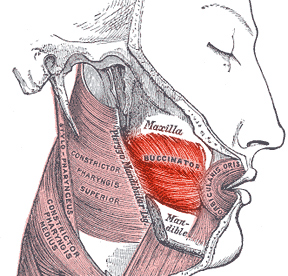
It originates from a ligament (specifically, the pterygomandibular ligament) on the bottom jaw, or mandible, and inserts into the orbicularis oris. It also helps out a lot during chewing.
The levator labii superious comes from the upper jaw bone, or maxilla, and inserts into the middle-side of the upper lip.

This muscle elevates the upper lip when contracted.
Then we have the zygomatic major and zygomatic minor muscles.
 |
| Zygomatic Major |
 |
| Zygomatic Minor |
Zygomatic major originates from the zygomatic bone and inserts into the corner of the orbicularis oris. It elevates the upper lip and also pulls back the angle of the mouth. Zygomatic minor also comes from the surface of the zygomatic bone and inserts into the mid-side of the upper lip. It elevates the upper lip.
The depressor labii inferioris originates from the mandible and inserts into the lower lip.

This muscle pulls the lips down and out, which also happens to open the lips up a bit (you can also think of this as the "pouting" muscle).
The depressor anguli oris comes from the mandible and inserts into the orbicularis oris at the upper corners.

This guy lowers the corners of the mouth and helps to compress the upper lip to the lower lip.
The mentalis comes from the mandible and inserts into the skin of your chin.

This muscle pulls the lower lip out, as well as elevating and wrinkling the chin...so this could be thought of as the "pout" muscle's accomplice.
Also, the platysma, which was mentioned here, makes another appearance, since it lowers the mandible and has a lot to do with jaw movement during speech...along with all the other jaw muscles, that is.
Okay, so that'll be my last post on musculature for a while. Now, I can get to what I consider the "fun stuff," the nervous system, physiology of articulation (which follows a bit of nervous system introduction) and a bit of the physics of sound. Where is this all going? I suppose I'm building up to my little theory of the relationship between vocal science and vocal pedagogy, what's sometimes missing from that relationship, and how this knowledge has really, really helped my singing along by quite a bit.
*Seikel, J. A., King, D. W., & Drumright, D. G. (2010). Anatomy and physiology for speech, language, and hearing. Clifton Park, NY: Delmar.
Subscribe to:
Posts (Atom)