Saturday, October 18, 2014

You have a vocal injury? How did you do it?

Singing world: We have a serious problem, and it must stop.

This problem is so pervasive that it still exists in the clinical world too:  The idea that someone might "cause" their vocal injury, and in doing so, that they (or their private voice teacher) are somehow guilty of some horrendous wrong-doing.  (Side-note:  This mentally does not exist in any clinician that I would ever recommend to someone.  It still exists in some, but not all.)  (Okay, side-side-note:  I was just a guilty as everyone in this mentality prior to entering speech-language pathology, but I have turned 180 on these beliefs and I think everyone else should too.  Here is why.)

Let's start with this example:  The Olympic gold-medalist Lindsey Vonn.  If you clicked on the link, you'll read about how she wasn't able to complete in the 2014 Winter Olympics due to a knee injury.  

How many of you out there thought to yourself:  "Well, Lindsey Vonn is a terrible skier.  She just doesn't have good technique.  She doesn't even train with a good coach.  I heard she makes poor decisions in terms of what course to run, what competitions to sign up for, and when to stop.  She just doesn't have what it takes to really have a career as a skier."

Personally, I've never heard of anyone looking at a high-level athlete and scoffing at an injury they may sustain.  So why do we singers do that to each other?  Now replace "Lindsey Vonn" with "Maria Callas," "Natalie Dessay," or "Julie Andrews."  Do the above comments seem more justified all of the sudden?  If so, WHY?  Why are professional singers any different than high-level athletes?  Why would sustaining an injury of any kind make a singer (or their voice teacher) automatically deserving of scorn?

Here's the big secret that really shouldn't be a surprise:  No one intends to injure their voice!  It's an accident that's scary to deal with.  There is no reason people dealing with the emotional impact of those consequences should also carry the guilt of causing their injury.  It's not a necessarily a sign of poor singing technique and it also isn't necessarily a sign of bad voice teaching.  Often, the direct cause of an injury is very hard to determine.  (NOTE:  Cause is different than time of occurrence.  In some injuries, like a vocal hemorrhage, we can determine the time or day that the injury likely occurred.  However, the direct cause of the hemorrhage can still involve multiple variables.)

Did you ever:
-Go to an amusement park and lost your voice a little from screaming on the roller coasters?
-Sing a well-paying gig while sick because you had just enough voice to get through the gig?
-Go out to noisy restaurants/bars regularly with your friends/cast mates after singing for hours daily?
-Unknowingly sung (uncomfortably) with acid reflux for several months before getting looked at by your doctor?

I bet most of you have at least done one of the things on that list.  In some people, some of these behaviors can contribute to the developing of a voice disorder and in others, no disorder develops.  Truth is, even the best vocal scientists can't predict who will develop a voice disorder/injury and who won't.  Too many factors are at play.

Blame does nothing but inflict additional damage to someone dealing with a medical condition. Injuries are accidents that happen sometimes to good singers and that need to be dealt with in the best way possible.  That is all.  Vocal injuries for a singer are exactly like a knee injury for a pro skier.  Until we can travel back in time and prevent accidents from happening, guilt and blame does nothing but make it worse.  What is needed is a good plan to get the voice to a condition that, ideally, will meet the patient's vocal needs.  That is what a medical team (e.g., ENT & SLP) is for.

So perhaps the next time you hear someone say he/she is dealing with an injury, instead of saying "How did you do it?"  Say "Oh, I'm so sorry to hear that" and maybe offer condolences and wish them a speedy recovery.

We keep calling ourselves "vocal athletes."  It's time we start treating each other as such, especially when an injury occurs.

Thursday, October 16, 2014

Hitting the ground running…and somehow finishing strong

Well, well.  It's been a long time since I've posted, hasn't it?  I've been thinking about getting back to blogging so very often over the past two years.  I just finished the Master of Science in Speech, Language, and Hearing Sciences in May, and I am now in my first semester of my PhD program.  My research is focusing on acoustics of voice and speech, and, clinically, I'm getting some fantastic training in order to specialize in voice therapy.

So, when I logged back in and looked at drafts of blogs I left unfinished, I found that wrote a short draft of a post I intended to publish after my first two weeks of grad school.  Here it is:

Grad school has started.  Folks kept telling me that you'll really hit the ground running in a clinical program, and they really weren't kidding!  In the past two weeks I've completed HIPAA training, read 15 articles/textbook chapters, been quizzed on eight of those articles, done my lesson plans for my first two clinical sessions, given those two clinical sessions, read through seven client files, and observed four hours of clinic.  My first research project is due in two weeks, and my first exam is the day after labor day.

On the plus side, I know this is all stuff I can handle, and I know that the faculty at my school are approachable, supportive, and brilliant.  They totally have our backs.  It always feels good to know someone has your back.

So I've been fluctuating between feeling all awesome-sauce and conquistador-like and feeling like a fraud, idiot, and incompetent a**, but I think it's getting better.  As long as the pendulum keeps swinging away from the "incompetent a**" feeling and moving more toward the "I've got this" feeling, I'll know I'm heading in the right direction.

Fast forward two years and I find it's a pretty good description of the program.  The pendulum did swing away from the "incompetent" feeling.  In a short two years, I ended up becoming a rather competent clinician.  But, man, was it an intense and stressful ride to get there!

Of course, now that I'm starting something new again with the PhD program, the pendulum has swung back to "incompetent" again.  (Ain't it always the way?)  Only this time it's in regards to all the fine details that goes into good research design.  I still feel pretty competent as a clinician, though, so that's good.

Anyways, I'm going to do my best to come back to regular blogging.  It's been so long that I honestly don't know where to begin.  There's some scientific stuff I need to correct in my anatomy and physiology section.  I would also like to write up some stuff about teaching singing more efficiently and maintaining a technique.  But for now, I might just jump in with things as they are in my life now and fill in as I go. Gotta get my feet wet again with this blogging stuff.

Monday, August 13, 2012

Physics of Sound: The Spectrogram (or what the heck am I looking at part 2)

I probably should give a little lesson on how to read a spectrogram, since my next post will feature spectrograms rather heavily.  I made all these spectrograms on PRAAT, which is free and downloadable if you wish to play with it.  (I know the website looks a little sketch, but I had to get it for my classes using the site I linked to and it's totally safe for your computer.)  PRAAT is a lovely piece of software that will record a sound and then give you both a spectrogram and a waveform of that sound.  As you look at the images below, the waveform is the image on the top with the thick black band and blue vertical lines, and the spectrogram is the grey-scale mess below that waveform.  So, on to the important part of this post!

How to read a spectrogram:

The x-axis (horizontal) is time, the y-axis (vertical) is frequency, and the grey-scale shows amplitude.  So a spectrogram can show three dimensions, time, frequency, and amplitude vs. a waveform that shows only two, time and frequency.  On fancier programs, the amplitude is sometimes shown in color, like having blue be the softest sounds and red being the loudest, but in PRAAT, the darker the band, the higher the amplitude.  In terms of the frequencies, I set the spectrograms to show from 0 Hz to 7000 Hz.  PRAAT can display up to 20,000 Hz, but then the formant bands I want to focus on get too squished together.  If you click and make the image bigger, you can see a dotted red line with a frequency number off to the left.  I set those lines there just to give you some idea of where the upper formant lies in terms of Hz.  And remember from the last post that the formant will be somewhere around this frequency, not right at the single frequency itself.

So this is what a typical spectrogram will look like with the upper frequency set at 7000 Hz.  (I think PRAAT's default setting is usually 5000 Hz.):


The spectrogram above is me sustaining the vowel /a/ with my speaking voice.  You can clearly see five dark bands going horizontally across the image, but the bottom two dark bands are the darkest, indicating that those are the highest amplitude formants.

Sustained-speech of an /a/ vowel with formants marked.
This is the same spectrogram as the one above it, but I've set PRAAT to show me the first five formants, which it does by adding in those red lines.  The software is simply determining where the highest amplitudes are and sticking bands in there.  I'm not controlling where those thick red lines go.

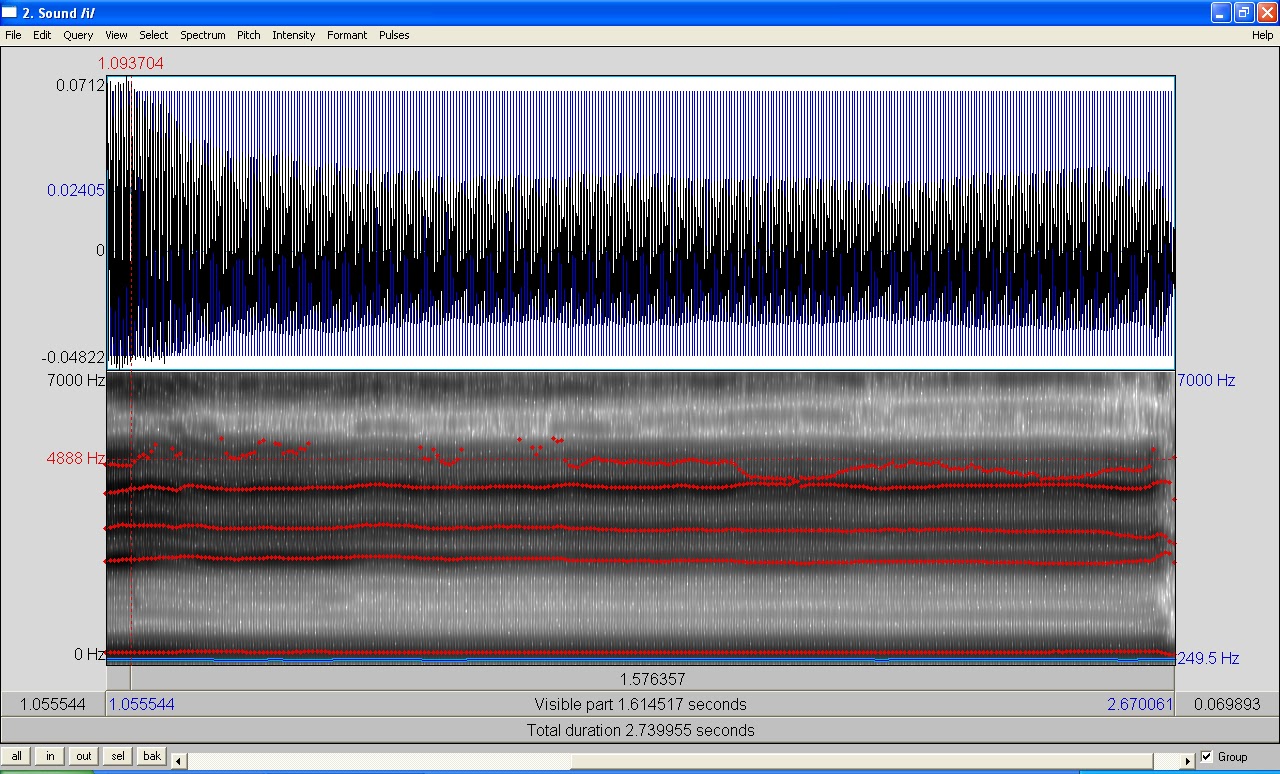
Sustained, spoken /i/ vowel, no formants marked in.
Here's me sustaining an /i/ vowel with my speaking voice.  Note the wide distance between the first and second formants, which is just what the /i/ vowel does.  Oh /i/, you so crazy!

Sustained, spoken /i/ vowel, first five formants marked in red.
Above is the same spectrogram again, but with PRAAT marking the first five formants in red.

Spoken phrase:  "One, two, three, go," no formants marked.
 And there's a spectrogram of me speaking the phrase, "one, two, three, go.'  Here, you can see the movement of the formants as I go through those words and the "white space" between the words.  (Those areas where there's a thick blue vertical band on the waveform is where the /t/ and the "th" sound of "two" and "three" are.  And, you can see the antiformants present in the /n/ sound right at the end of the first word "one."  Pretty cool, huh?)  (Scroll to the bottom of page 2 on that antiformant link to read more about them.) And here's the same phrase with the formants marked in:

"One, two, three, go," with formants marked in red.

Now, some super cool people can actually read spectrograms like they're reading words off the page.  I'm not quite that awesome yet, but if you tell me what the phrase is, I can pick out where each specific word is using my knowledge of vowel formants and consonant frequencies.  It'd be cool to become that person who can just read them, though!

Now the reason I kept setting the spectrogram to 7000 Hz instead of 5000 is two-fold:  First, I wanted to make sure the upper formant wasn't cut off since that formant does occasionally go higher than 5000 Hz, and second, I wanted you to see that there actually is a thick band of amplitude above the 5000 Hz mark, which you can see in the spectrogram above.  So there are more "formants" above that 5000 Hz mark...we just don't really regard frequencies higher than 5000 when discussing speech or singing very much.  (Although, this article does!)  Heck, PRAAT doesn't even mark in any formants above the 5000 Hz area...usually the fifth formant area.  But, I wanted to make sure you know that it's not like formants and harmonics just disappear above 5000 Hz.  Mathematically speaking, harmonics would just keep on going higher and higher, and so would formants.  However, the amplitude lessens the higher you go, so vocal harmonics and formants do dampen out eventually...just not at 5000 Hz.

Up next:  The singer's formant!  I'mma gonna break apart a common misconception in the hopes that it clarifies what is we're actually doing when we carry over that orchestra.

Physics of Sound Series: Formants, formants, and more formants

According to Raphael et al., the source-filter theory of speech production states that the source of vocal sound, i.e. the vocal folds, is filtered through the air spaces in the vocal tract (p. 330).*  This is a fairly simplistic model of vocal production, but it is very useful just because of its simplicity.  Other models of speech production out there get a lot more detailed, but for a general, conceptual knowledge of the relationship between the vocal folds and vocal tract in terms of acoustic output, I think the the source-filter model can't really be beat.

So what does this have to do with formants?  Well, on the last physics post, I left off by stating that the vocal tract can change it's shape and configuration to filter out different harmonics from the same sound source.  The shape of the vocal tract will also amplify certain harmonic frequencies, while dampening others.  The resulting "peaks" in amplitude at specific frequency ranges are what we call formants.  One important thing to note here is that formants are not the same thing as harmonics.  You can think of formants as being a certain specific collection of harmonics, so the first formant is not the same as the first harmonic.  The idea of a harmonic is that it is one particular sine wave that is related, mathematically, to the fundamental, but the formants are collections of these sine waves.  The language you typically see is that the first formant is around a specific frequency.  So while you might read about the singer's formant being somewhere around 3000 Hz, the formant isn't actually only at 3000 Hz, it's just a collection of frequencies centered somewhere around 3000 Hz.  I think the semantics might get a little fuzzy there for a lot of people, but what seems like a little, unimportant detail actually makes a big difference when discussing harmonics vs. formants.  If you use those terms interchangeably, you'll just confuse the folks who know they're different things and then you'll get confused that they're confused and yadda yadda yadda...

Think of it like this:  Let's say you have a collection of all the Star Trek episodes from every Star Trek series, even the crappy ones.  If you consider the first series, the original Star Trek, as the fundamental, the first "harmonic" would then be Star Trek:  The Next Generation, the second would be Deep Space Nine, the third Voyager, etc.  However, it's possible that if these "harmonics" get filtered into formants, the first formant could consist of the first five seasons of The Next Generation, with the last two seasons filtered down to really low amplitude.  The second formant could be the last four seasons of Deep Space Nine, with the first three seasons of DS9 being filtered down.  The third formant could be the last five seasons of Voyager with the first two seasons filtered down, etc.  See the difference?  So harmonics are the building blocks of formants, but harmonics come from the resonance of the vocal folds themselves and formants come from the resonance of the acoustic filter or vocal tract.

What's great about formants is that they happen to be the way we distinguish vowels during speech.  In fact, the relationship between vocal tract shape and the acoustic output (vocal sound once it exits the mouth) is so interrelated, we are able to classify vowels by both the vocal tract shape and the acoustic output, depending on what we're talking about.  I.e.:  Talking about articulation?  You'll be talking about the shape of the vocal tract made by the articulators (tongue, soft palate, etc.).

If you happened to click over to that Wikipedia article on vowels, you probably noticed there's a section on articulation and a separate section on acoustics.  The position of the tongue in the mouth happens to make the biggest difference to the overall shape of the vocal tract, and so, a lot of vowels can be categorized by place of tongue articulation during production.  For example:  An /i/ ("ee") vowel is categorized as a high, front vowel because the tongue is positioned very high near the roof of the mouth, but it is also positioned quite forward in the mouth and is, therefore, a high-front vowel.  A high-back vowel, such as /u/, has the tongue positioned as a "hump" near the back of the mouth, so it's high, but in the back.  A low vowel, such as /a/, doesn't involve the tongue in a raised position at all, and is closer to a neutral vowel position, of which the schwa sound is considered the most neutral.  (I know a lot of singers consider /a/ as the most neutral vowel, but linguists and speech scientists have researched tongue positions, and schwa is indeed the most neutral.  I think the reason singers like the focus on /a/ so much more is that we don't tend to sing schwa very often, and if we do, we don't sustain a sound on schwa.  So schwa gets kinda a bad-rap in the singing world, but it is an important little vowel in spoken language.)  

Because a larger space will resonant at lower frequencies, and a smaller one at higher frequencies, the formants are a result of the size of the pharyngeal space and/or oral space as determined by the tongue position, primarily.  A good example of this is if you tap on a glass with some water in it, then tap again after drinking the water, the second tap will be a lower pitch than the first tap because there is more air inside the glass after the water is gone to resonant the sound.  Or a better example:  A cello is bigger than a violin.  So...there you go.  Therefore, in a simplified sense, these tongue positions all correspond to the formant frequencies of each vowel.  The /i/ vowel is known for having a low first formant (more pharyngeal space created by the high tongue position) and a high second formant (small oral space created by tongue position,) and in fact, this vowel has the widest space between the first and second formant as it's trademark sound.  The /u/ vowel has a low first formant (from the high tongue position creating more pharyngeal space), but also has a low second formant (from the tongue position being near the back of the mouth, creating more space in the oral cavity).  Once again, this is a very simplified way of looking at this, but it's an easy way to understand the basic idea.  Just be aware that the science of acoustics can get pretty darn complicated in this area.


*Raphel, L. J., Borden, G. J., Harris, K. S. (2007).  Speech science primer:  Physiology, acoustics, perception of speech (5th ed.).  Philadelphia, PA:  Lippincott Williams & Williams.

Thursday, July 26, 2012

The power of kindness

I keep a regular yoga practice.  I mainly practice at home, since it's free to do there, but I also attend yoga classes regularly at a good studio.  I tend to do yoga about two to three times a week.  However, this past spring semester, I ended up only practicing once a week, at most.  So, I got decently out of shape from what I'm used to and I ended up hurting my left hamstring, somehow.  What sucked the most about this was that my left leg has always been more flexible than my right leg, while my right leg tends to be stronger, so I was usually able to do hand-to-foot pose and this one-legged arm balance with my left leg pretty easily, while I still struggled a little with the right.  However, this summer, while I've been trying to nurse my left hamstring back to health, my sides have reversed.  I'm still not able to do these poses, or others like them, with my left leg, but I've gotten them down with my right.

So just today, while I was practicing at home, I realized that I've been so careful with my left leg this past few months that I've actually let it become weak.  I've stopped trying to engage the muscles on that leg as much because of the injury.  Of course, this is not helping recovery at all, so today, I started forcing that leg to pull it's weight, and while my hamstring still isn't totally better, I actually got my full trikonasana on the left side back today and my hamstring feels better now than it has in a long time.  I'm sure the more I focus on working the muscles on my left leg, the better it will get, and I will be back to my normal yoga practice pretty soon.

This little experience with my hamstring really reminded me of my vocal recuperation, probably because I had a conversation with another singer dealing with their own voice disorder just this week.  See, the thing is, I was acting like my hamstring was still injured, even though it's been months since the actual injury.  My hamstring is quite likely healed up, it's just healed tighter than it was before.  Because of this tightness, I've been avoiding really using it in yoga, making modifications on the left side for any hamstring-intensive pose and just allowing my lunge on that side to kinda go out of form.  In essence, I was allowing my muscle to stay weak just because I was still acting like something was wrong with it well after it was healed up.  In an earlier post, I said I had a hard time learning to trust my voice after it was healed up, because I felt like my voice had betrayed me by being injured.  But I've talked to a few singers out there dealing with injury who have the added issue of still feeling like their voice is injured even after therapy is completed and they're given a full bill of vocal health by their team.  So they're still fighting with their voice and letting it do the wrong things because they still think it just doesn't "work right," even though it does.  It's a mind game, isn't it?

What these injuries really do to us is force insecurity upon us, so naturally, our reaction is to defeat the insecurity.  Attack it full on so that we can get past it as quickly as possible.  But when this tactic burns out, as it often does for many people out there, we start to retreat into the insecurity, allowing it to defeat us and beat us down until we give up.  This can lead to regret and perhaps even bitterness for so many of us, and maybe we find the fire to fight again and maybe we win, but what if we just changed our perspective of this insecurity?  What if, instead of fighting, we decide to accept this weakness that has been thrust upon us and still decide to be kind to ourselves?  And what if, by being kind to our whole new self, insecurity and weakness and all, we learn how to patiently and diligently work through our injury, not by forcing ourselves to be as we were before, but by moving toward being someone new and different because of this experience?  What if all we need to do is realize that healing doesn't typically mean going back to how things were before, but it can mean becoming better than we were before?

I suppose saying I'll get back to my normal yoga practice is a bit of a lie, because before this injury, my right side was more inflexible than it is now.  If my left side is restored to it's former, flexible state, my whole body will actually be more balanced than it was before this.  Just like how, even if my voice is only better because of being healed and the glories of vocal technique, I'm a better, more joyful singer because there was a time when singing was taken away from me.  So to all those out there recuperating from any injury:  May recovery make us all stronger, more balanced, and more joyful; may we be kind to ourselves and patient with our injury as we build our strength back up; and may we all realize that we will never be the same...and that can certainly be a good thing.

Why yes I DO like school, thank you very much

There's a common statement I tend to hear from certain people when they find out that yes, I am going back to school for yet another graduate degree:  "You must like school."  This statement is always delivered with a bit of snark and a slight roll of the eye, and it is usually said by people who say they were "never good at the whole school thing."  That phrase is almost always followed up with the person explaining how great their (insert job title with major company) is and that they get paid (insert regular hourly wage/typical management salary) and they never needed a degree to do it.  The rather clear subtext to this exchange is thus:  "You poor, nerdy sap.  You must be in school because you're avoiding the real world.  You should suck it up and just get a job like everyone else."

What I find the most interesting about these exchanges are the implicit assumptions that are made about people who seek additional degrees at all.  The main assumption tends to be that anyone who gets a degree higher than a bachelor's or a second bachelor's is a "career student;" you know, someone who's just avoiding adult responsibility by staying in school as long as possible.  I find this assumption interesting in light of two facts:  The fact that I have been out of school for several years now and have been an independent adult through all of those years, and the fact that there are a lot of health/medical professions that require a graduate degree for licensure.  I know I can't expect the general populace to know what requirements there are for certain professions, but why do some of these folks not drop the snark when I tell them that?  Why not just trust that those degrees are required because there is a vast body of knowledge and many hours of training required to do the job effectively?  People trust MDs are valid professional graduate degrees, so why not trust that physical therapists, occupational therapists, physicians assistants, audiologists, speech-language pathologists, etc., need advanced knowledge to effectively do their job?

But it's the implicit insult that really gets me:  "Nerd."  Now, I know that in today's society, the term "nerd" has been usurped to mean anyone who's really, really into pretty much anything and is not really seen as an insult anymore, but in this setting, it's intended as one.  Perhaps there are just too many grad students out there who are intellectual snobs.  Maybe these folks have encountered so many of those snobs that they get all defensive and mistakenly think someone with multiple degrees is automatically a snob.  I can definitely sense a bit of insecurity from the other person in this exchange.  Maybe they always wanted more out of life, but gave up on their dreams.  Maybe they always struggled in school and felt inferior to a sibling or friend who always found school easy.  Maybe they did well in school, but only because of a near-abusive "tiger mom," and so they hated school as much as they were good at it.  As much as I believe insecurity is nothing to be ashamed of, I also believe personal insecurity is never a valid excuse for making another person feel like crap.  I believe this as much as I believe that salaries and job titles do not define the intrinsic worth of another human being.

My reactions to these situations have never been the best.  I usually end up explaining the good employment prospects and the typical starting salaries in the field, but this is in stark contrast to the belief I just stated above, isn't it?  So I end up feeling put down, but also a little dirty for defending my life decisions based on their criteria of self-worth.  The thing is, that is not my criteria.

So, after having one too many of these situations in the past, I have decided to arm myself with a response I can feel good about (which will be truncated in real life):
Why yes, I do like school.  I like to learn.  I enjoy broadening my mind and discovering new and exciting things that I never knew about before.  I like the idea of helping forward the advancement of society and human knowledge through research.  I like the pragmatic side of this new field, where I get to help an individual who is struggling with a disorder that keeps them from effectively communicating.  I like school.  I like that it is not only an avenue through which I can pursue my dreams and sharpen my mind, but it is also a safe place to learn, try, discover, fail, try again, and, ultimately, succeed.  I like learning, and I like that I will continue to learn, grow, and develop throughout my life thanks to the mental training higher education has given me.  With all the people in the world who use knowledge and education to keep others down, I like that I am becoming someone who will counter those greedy individuals, and who will use her knowledge and education to help others in need of it.  I think education provides me with a value beyond just a salary and job title.  It provides me with a sense of purpose and direction and the ability to accomplish my goals.  Isn't that ultimately what we are all searching for?

Friday, July 13, 2012

Physics of Sound Series: Harmonics and fixed strings and open-closed tubes, oh my!

So, we've got the vocal folds acting like a fixed string with multiple resonant frequencies called harmonics, but before we go further, I realized there was some terminology that I should go over.  Remember how the actual sound wave produced from vocal fold vibration is far more complicated than that of a single string?  That's mainly due to the motion of the lamina propria, but even single strings can produce complex sound waves.  This is a wave pattern that is created from the interaction of multiple frequencies known as harmonics.  If you have several, or even thousands, of simple sine waves that are harmonically related, you've got a complex periodic sound wave.  Periodic means it still has a predictable pattern, as opposed to complex aperiodic waves, like white noise.  But the linguistic signal contains both periodic and aperiodic waves.  Periodic would be vocal sounds, like vowels; aperiodic would be like unvoiced consonants like /s/, and a combination of periodic and aperiodic happens during a lot of voiced consonants, like /z/.  We're just going to focus on complex periodic waves for the purposes of understanding resonance more fully.  Complex periodic waves can be broken down into their simple sine wave components by using something called a Fourier transform.  We certainly won't go through the math for all of that, but just know that all complex periodic waves are made up of simple sine waves, and even though the vocal folds create a more complicated sound than a string does, we're going to continue with the string comparison cause I think it makes everything so much easier to visualize.


The thing about vibrating strings fixed at both ends is that they have a fundamental resonance of 2 times the length of the string.  This just means that one-half of a wave can "fit" on a string at any given pass along the string.  It also means that the string will vibrate at both even and odd harmonics of the fundamental.  This can be represented mathematically if we use our knowledge of frequency = velocity divided by wavelength.  In this basic case, we're going to consider velocity to be the speed of the wave being produced, and in the human voice, that speed is determined by the tension and mass of the vocal folds.  So when the folds elongate, tension increases and mass decreases resulting in a high frequency of vibration (cool, huh?).  And the wavelength, thanks to the half-wave resonator we're working with here, will be two times the length of the string (or folds).  Using this equation and setting our speed at 340 meters per second, the approximate speed of sound at sea level, we can figure out the harmonics of a 1 meter string.  The fundamental frequency would be 170 Hz, the first harmonic would be 340 Hz, the second harmonic would be 510 Hz, the third 680 Hz, the fourth at 850 Hz etc.  This sound wave (up to the fourth harmonic) would sound like this:


Now that we've compared the vocal folds to strings, what do we have to compare the vocal tract to?  An open-closed tube!  ...which is not that exciting at all.  But what the vocal tract does is pretty darn exciting.  Of course, the vocal tract itself can change it's shape for communication and such, but the open-closed tube is a good simplification of what the basic function of the vocal tract is.  An open-closed tube is a quarter-wave resonator, as opposed to the half-wave resonator that the string up there is.  So what does that mean?  A quarter-wave resonator means that only a quarter of the wave can "fit" during one pass through the tube.  So this resonator only vibrates at odd harmonics of the fundamental frequency.  So, if we look at that 170 Hz frequency produced from that meter-long string up there, The open-closed tube resonating at this fundamental 170 Hz would have a length of 0.5 meters and the first harmonic would be at 510 Hz, the second at 850 Hz, etc.  Notice something there?  This tube is only resonating at even frequencies of the string up there.  So what happens to the sound wave produced by that string as it passes through this tube?  Well, it'll sound something like this:

File made with Audacity

Where did those other harmonics go?  The tube ate them.  No really!  Well...it kinda-sorta did.  See, the tube acts as a filter for that sound wave.  Those missing frequencies, the ones that the tube won't resonate, are going to be filtered out due to destructive interference, while the frequencies the tube vibrates at are going to constructively interfere and exit the tube for us to hear.  Yup, that's right.  Without resonance, we wouldn't hear our own speech, much less a singer singing over an orchestra.  Your voice is always resonating all of the time; it's just that opera singing requires a difference resonance than your speaking voice...obviously.  We don't really sound like we're talking when we're singing, do we?  

Now, I don't know about you, but I personally find the second audio file a little more pleasing than the first.  The first one is objectively "richer," in the sense that it has more harmonics, but the second one subjectively sounds "richer" to me.  I'm not really sure why, but I suspect it has something to do with the fact that I am physiology wired to find the sound of the human voice important, as are you, and so perhaps I also find sounds from an open-closed tube more pleasing?  (And if you didn't find this to be true, you're really messed up!  Just kidding.)  And where this "pleasing" association would occur in the brain, I'm not sure.  But I know my brain is associating the second file with a richer sound that I happen to find more pleasing, because the first sound has more harmonics in it for sure...I would know; I inputted the frequencies myself!  But if you played those two tones for me without my knowing about the harmonic structure, I would assume the second one has more harmonics.  The brain sure is one crazy organ, amirite?  Of course, I digress, but this is an example of some of the stuff people are trying to figure out in terms of how we listen, pick out, and associate the speech signal into meaning in our lives all day long.  It's some cool stuff, for sure.  Perhaps I'll learn an answer to that soon and will update you guys.

Now, in a stationary tube, the harmonics are pretty fixed, but lucky for us, our vocal tract can change shape, length and configuration to produce a lot of different sounds.  By changing it's shape, the vocal tract filters the same sound source differently, producing all of the different sounds we make in our languages and then some.  Conveniently for us, it seems to do this pretty much on auto-pilot most of the time, like when we're speaking, or how the vocal tract lengthens when our voice drops in pitch (the larger cavity will resonant at lower frequencies and shorter at higher).  The shape the tract takes determines which frequencies are amplified and which ones are dampened out.  And this sets us up quite nicely to talk about formants next time, doesn't it?

Resources: 


Raphel, L. J., Borden, G. J., Harris, K. S. (2007).  Speech science primer:  Physiology, acoustics, perception of speech (5th ed.).  Philadelphia, PA:  Lippincott Williams & Williams.